Thinking about trading suburban convenience for self-sufficient living? Homestead houses represent a specialized category of homes designed around food production, resilience, and long-term family stability. Understanding what makes these properties unique can help you find the perfect fit for your dreams of rural living.
- Quick Answer: What Is a Homestead House?
- Homestead Houses vs. Conventional Suburban Homes
- Key Design Features of a Modern Homestead House
- Specialized Homestead Spaces (Kitchen, Pantry, Shop & More)
- Choosing Land & Location for Your Homestead House
- Building vs. Buying a Homestead House
- Energy, Utilities & Resilience Features
- Real-World Homestead House Examples
- Planning Your Own Homestead House
Quick Answer: What Is a Homestead House?
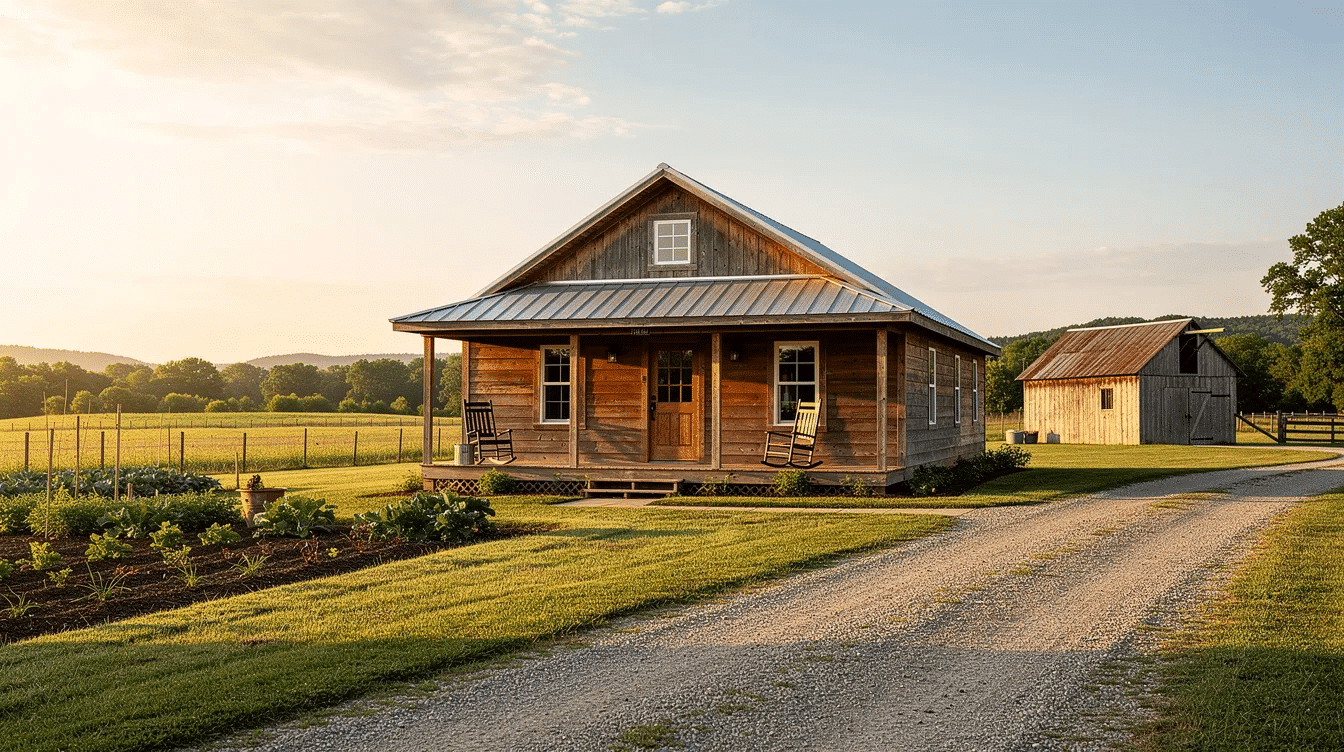
A homestead house is a primary residence designed for self-reliance, food production, and multi-generational family living.
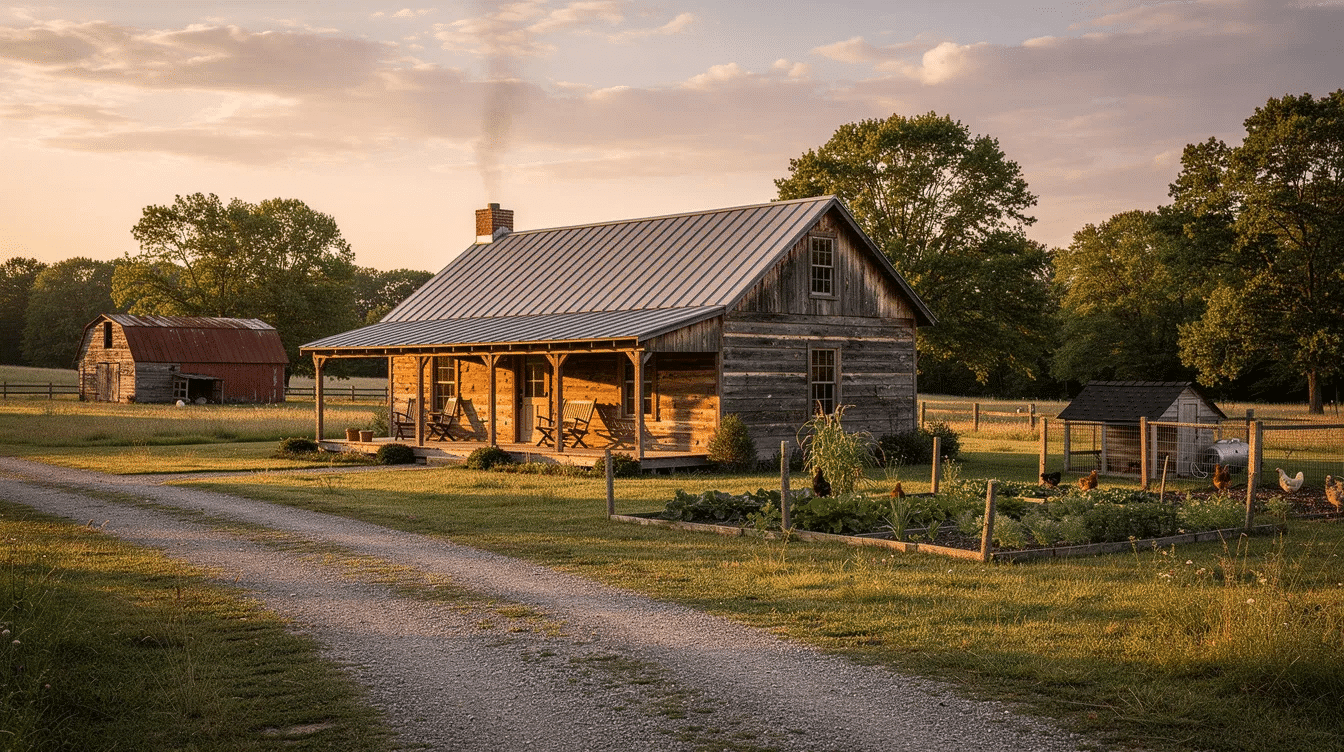
Unlike conventional homes, homestead houses sit on 1 to 20+ acres and integrate gardens, small livestock areas like chicken coops or goat pens, and ample storage for preserves, equipment, and bulk goods. These properties prioritize productivity over aesthetics—making them ideal for families seeking independence from supply chains and grocery stores.
Concrete examples exist across the country. In 2024, real estate listings near Homestead FL featured 3-to-5-acre parcels with 3-bedroom homes around 1,800 square feet paired with barns for hay and tools. In the Midwest, classic farmhouses built between 1900-1950 have been restored with modern insulation and solar to support gardening, homeschooling, and home-based income.
This article will guide you through house plans, design features, and practical considerations for building or buying your own homestead property.
Homestead Houses vs. Conventional Suburban Homes
Homestead houses prioritize productivity and resilience over commuter convenience and HOA compliance. Where suburban tract homes emphasize curb appeal and proximity to shopping, homesteads focus on self-sufficiency and reduced dependence on external supplies.
Here’s how they compare:
- Lot size: Suburban homes typically sit on 0.1-0.25 acres; homesteads range from 1-20+ acres
- Utility dependence: Suburban homes rely fully on municipal services; homesteads often incorporate wells, septic, solar, and woodstoves
- Storage: Suburban garages hold cars; homestead outbuildings store tractors, livestock feed, and canning equipment
- Kitchen design: Small suburban kitchens assume takeout; homestead kitchens handle 50+ quarts of canning per batch
Consider the contrast: a 3-bed, 2-bath 1,900 sq ft tract home built in 2015 in Homestead FL on a 0.15-acre lot versus a 2,400 sq ft farmhouse on 7 acres in central Florida, renovated in 2022 with solar panels and 5,000-gallon rainwater catchment.
One family who relocated from a 2020 subdivision to a 5-acre property reported 30-50% grocery savings after establishing their garden and livestock—though they faced initial challenges with zoning limits on animal density.
Key Design Features of a Modern Homestead House
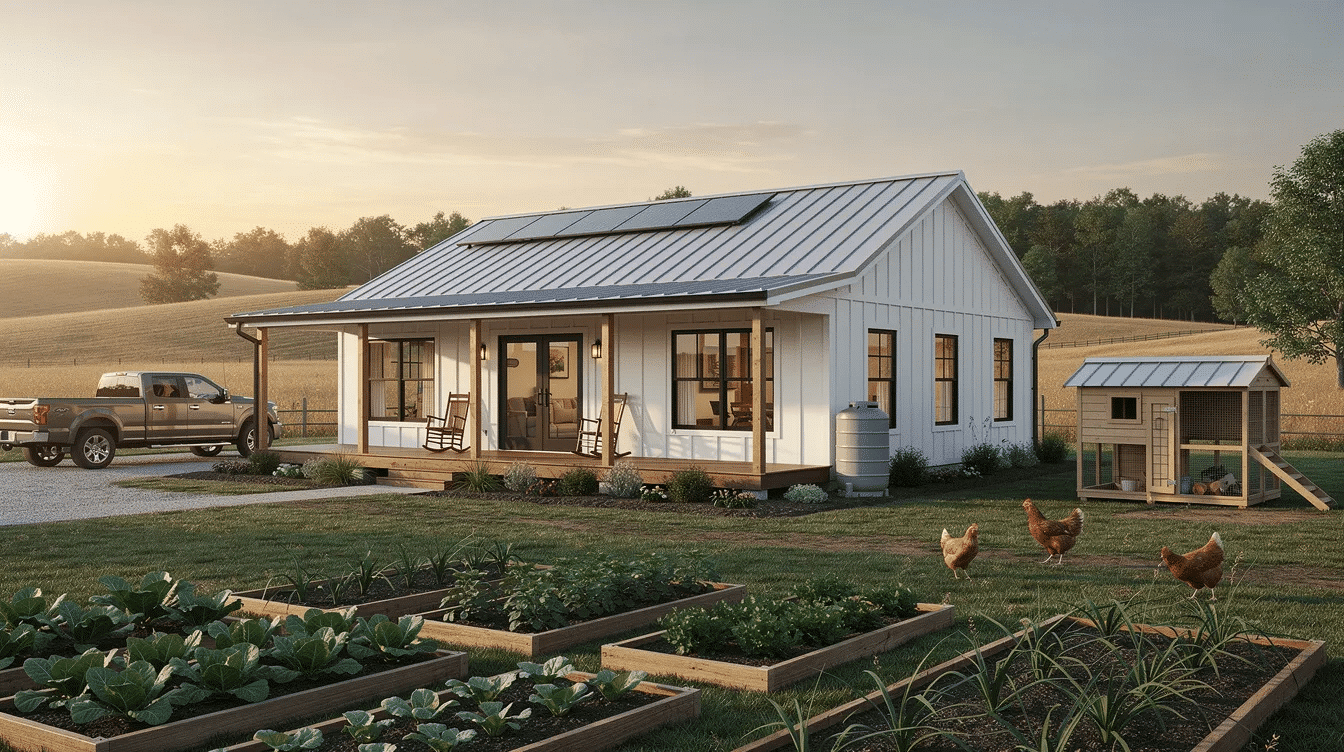
Design choices determine how well your house supports gardening, food storage, homeschooling, and home-based income. Smart planning during the design phase means fewer expensive renovations later.
Orientation and light matter significantly. South-facing living spaces and clerestory windows maximize passive solar gain in winter (adding 10-15°F in northern climates) and provide year-round natural light. Wide verandahs extending 10+ feet around the house offer shade and rain protection.
Essential interior spaces include:
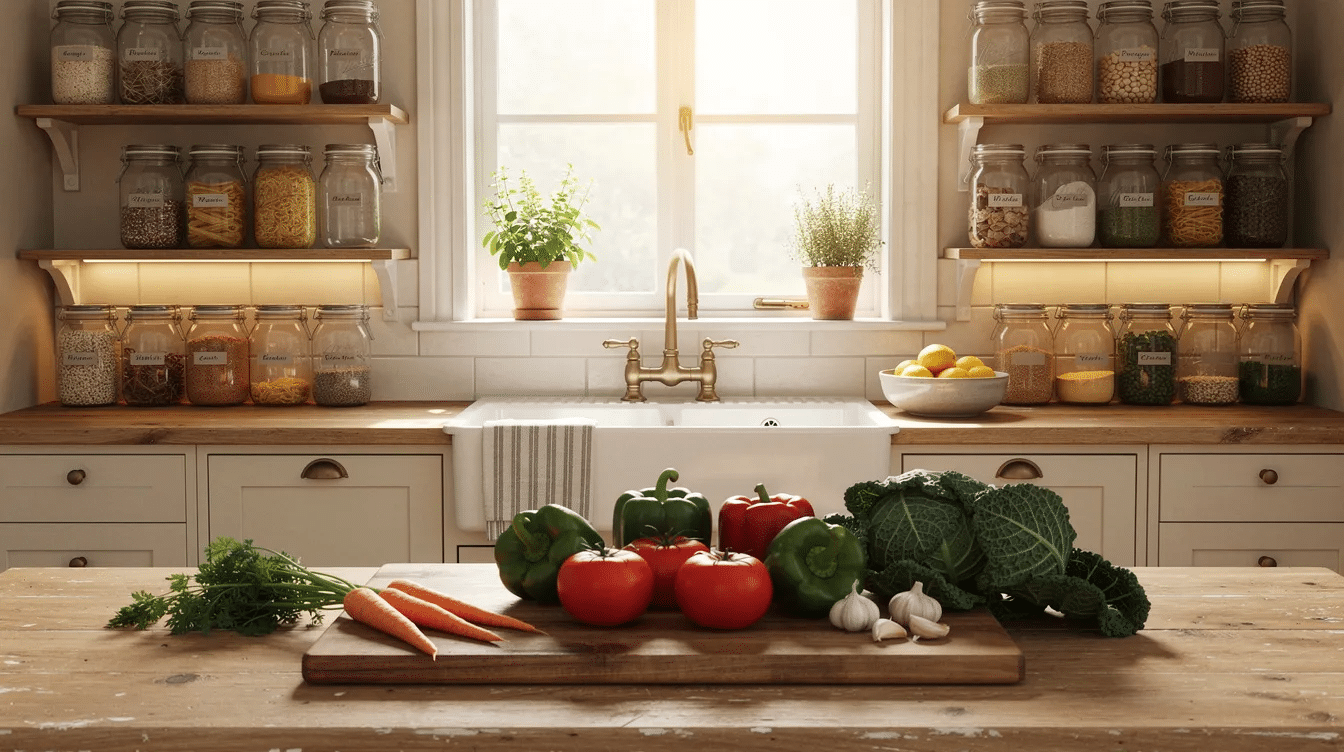
- Large kitchen with 10+ linear feet of counters
- Walk-in pantry with room for a chest freezer
- Mudroom with hooks, lockers, and a half bath
- Flexible great room (400-600 sq ft) for family activities and homeschooling
Durable finishes handle heavy traffic: sealed concrete or luxury vinyl plank flooring, washable wall paints, and reinforced entryways for livestock gear, while floor plans often borrow the open, single-level flow and outdoor connection that define a classic ranch style house. Metal roofing lasts 40-70 years, while fiber-cement siding resists pests and fire.
For mechanicals, plan 200-amp electrical service if you’re thinking about adding a shop, and rough in plumbing for future expansions like a canning kitchen. Most homesteads range from 1,400-2,800 square feet across 3-5 bedrooms.
Specialized Homestead Spaces (Kitchen, Pantry, Shop & More)
Homesteaders constantly agree that a big kitchen, serious pantry, and functional workshops top their priority lists. Here’s what these spaces need:
Kitchen essentials:
- 36-48 inch professional range
- 10-15 linear feet of counter space
- Farmhouse or double-bowl sink (36 inches+)
- Dedicated canning workspace for pressure canners and dehydrators
- Wall-mounted pot racks or island storage
Pantry requirements (60-120 sq ft walk-in):
- Deep shelves at 12-18 inch depths for Mason jars
- Cool, dark conditions maintaining 50-60°F
- Space for 15-25 cubic foot chest freezer
- Root cellar zone for 500+ pounds of potatoes
Mudroom features (80-120 sq ft):
- Built-in lockers or cubbies (24×72 inches per family member)
- Bench and hooks for coats
- Waterproof floor with drain
- Adjacent half bath with utility sink
Workshop and car garage space:
- Minimum 24’×24’ footprint for tools and small tractor parking
- Epoxy floors and pegboards
- Seed-starting shelves with LED grow lights
- Loft storage for hay and equipment
Optional areas like a homeschool room, home office, craft room, or guest suite for visiting family add 100-160 sq ft each. Plenty of natural light and built-in shelving make these spaces functional for multiple uses.
Choosing Land & Location for Your Homestead House
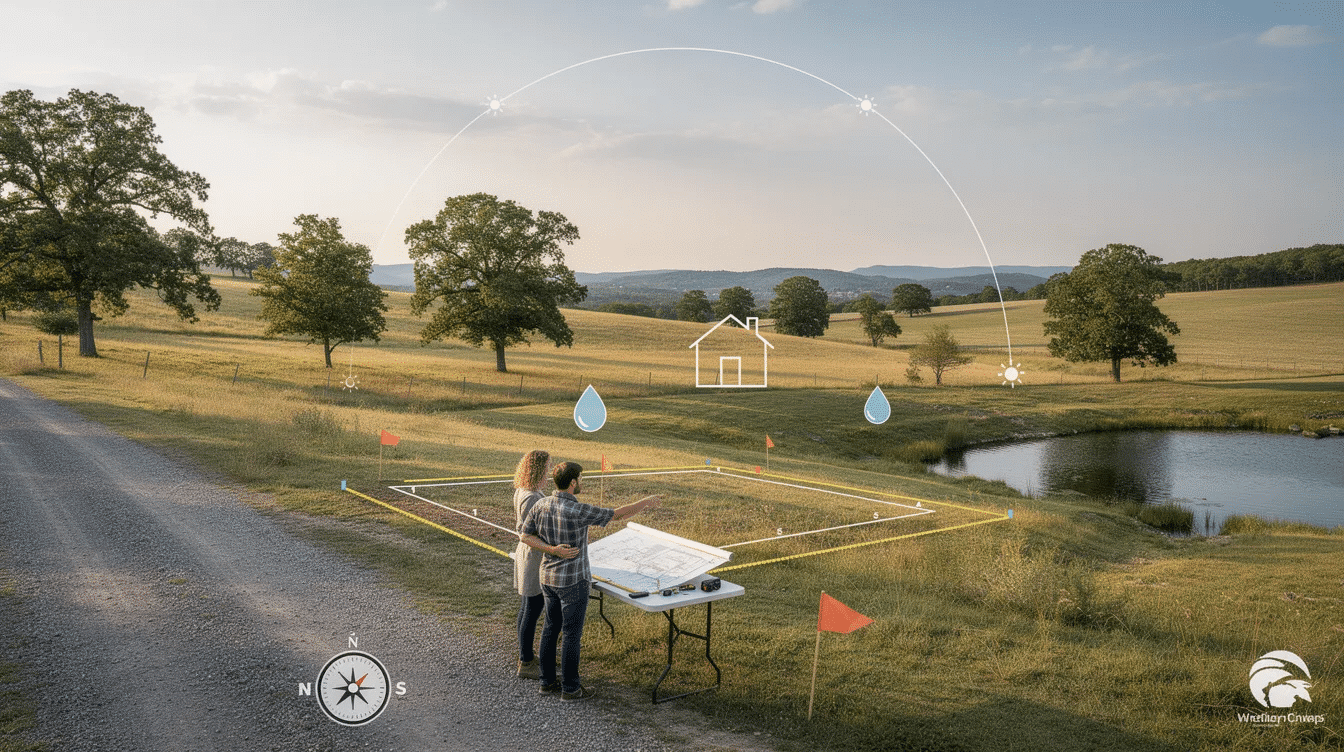
Land choice often matters more than the existing house. Between 2024-2026, rural land prices rose 15-25% in states like Florida and Georgia, making careful research essential before any sale closes.
Acreage needs by goal:
- 1-2 acres: Intensive gardens and micro-livestock (20 chickens, 4 goats)
- 5-10 acres: Rotational grazing for 2-4 beef cattle or dairy operations
- 20+ acres: Woodlots providing 10 cords of fuel annually
Water access is critical. Rural wells average 120-300 feet deep, yielding 5-15 gallons per minute in the U.S. Midwest and South. Rainwater systems can capture 600 gallons per inch of rain from a 1,000 sq ft metal roof, stored in 2,000-5,000 gallon cisterns.
Zoning and regulations vary by county. Agricultural zoning permits livestock and farm stands; residential zoning may restrict roosters or roadside sales. Research county GIS maps and soil surveys before purchasing to explore your options.
Distance to services matters too. Expect 20-45 minute drives to groceries, veterinarians, and hospitals. This metric affects your storage needs and backup systems.
Consider the difference: buying 3 acres with a 1970s house outside Homestead FL ($450,000 in 2024, needing $50,000 septic upgrade) versus 10 bare acres in central Georgia ($200,000, allowing custom build at $250/sq ft but requiring 12-month permitting).
Building vs. Buying a Homestead House
The core decision between renovating an existing farmhouse or building new depends on market conditions, timeline, and budget. Post-2020 material costs rose 40%, and labor shortages extended timelines—information worth considering when you’re weighing compact, single-level layouts similar to many ranch-style homes that redefine comfort.
Buying existing homes offers speed. Common finds include 1960-1985 ranch homes on 2-10 acres with solid block foundations but cramped 40 sq ft kitchens. Typical renovations include, especially if you’re updating older ranch style homes:
- Kitchen expansion ($30,000-60,000)
- Adding a mudroom
- Insulation upgrades to R-21
- Window replacements ($15,000-25,000)
Building new provides custom layouts optimized for homesteading, modern insulation, and integrated solar design. Expect $160-300 per sq ft in rural areas as of 2025, excluding land. That means $350,000-$700,000 for a 2,000 sq ft house.
Realistic timelines:
- Moderate renovation: 3-6 months
- New construction (design through move-in): 10-18 months
Financing differs too. Conventional mortgages work for existing homes; construction loans (5-7% interest, 20-25% down) fund new builds. An LLC structure may help with financing and liability.
Never skip inspections. Full home checks run $500-800, plus separate well flow tests and septic evaluations. About 30% of 1970s rural septic systems need pump replacements—costing $15,000-30,000 if failed.
Energy, Utilities & Resilience Features
Many homesteaders aim for partial grid independence, especially after major weather events like Hurricane Irma (2017) and Texas winter storms (2021). These systems provide security when infrastructure fails.
Grid-tied solar with battery backup:
- 5-12 kW arrays at $25,000-40,000 post-incentives
- 10-30 kWh batteries for 3-5 days of essentials
- Covers well pump, fridge, freezer, lights, and internet
Heating and AC options:
- High-efficiency heat pumps (18-25 SEER, $8,000-15,000)
- Woodstoves sized to your space (40,000-60,000 BTU for 1,800-2,400 sq ft)
- Ceiling fans for comfort and passive cooling
Water systems:
- 1/2-1 HP well pump with 44-gallon pressure tank
- Hand-pump backup for emergencies
- Rainwater collection (1,000 sq ft roof yields ~600 gallons per inch of rain)
Backup power options:
- 7-22 kW standby generators with auto-transfer switches ($10,000-20,000)
- 500-gallon propane tank runs fridge and freezer 7-10 days
- Portable 5 kW generators for minimal essentials
Septic systems for 3-4 bedrooms handle 400-600 gallons daily. Where legal, greywater diversion routes laundry water to orchards, cutting septic load by 30%.
Real-World Homestead House Examples
These fictionalized composites reflect common setups seen in U.S. homesteading communities from 2018-2025. Each demonstrates different approaches to homestead living.
Example 1: Five-Acre Florida Homestead A 1,750 sq ft concrete block house built in 1995 near Homestead FL, updated in 2024 with standing-seam metal roof, 7 kW solar array covering 70% of energy needs, and a 400 sq ft canning kitchen addition with 48-inch range. The 1-acre mixed orchard yields 2,000 pounds of citrus and mango annually. Activities include poultry and intensive vegetable gardening.
Example 2: Midwest Renovated Farmhouse A 2,300 sq ft 1910 farmhouse on 12 Iowa acres, renovated in 2022 with spray-foam insulation (R-28 walls), 100 sq ft pantry storing 1,000+ jars, attached 120 sq ft mudroom, and detached 30’×40’ pole barn workshop that borrows some of the open, indoor–outdoor flow seen in many beautiful ranch homes. The owners practice rotational grazing with 3 beef cattle and maintain seed-starting benches for spring planting.
Example 3: Small Mountain Homestead Cabin A 1,200 sq ft cabin built in 2018 on 4 wooded Appalachian acres. Features include 60,000 BTU woodstove, 3,000-gallon rainwater storage, terraced garden beds, and a separate 200 sq ft studio for remote work—illustrating many core mountain house design principles. Micro-livestock includes bees and dairy goats.
Planning Your Own Homestead House
Ready to start? This way of thinking turns your vision into reality through systematic planning over the next week, month, and years ahead.
Start with a 5-10 year lifestyle plan:
- Desired food production percentage (50% is achievable on 2 acres)
- Family size changes (add 200 sq ft per child)
- Home business goals (office + shop requirements)
- Anticipated mobility or health considerations (single-level or ramps)
Key planning steps:
- Define must-have spaces (canning kitchen, mudroom, storage closet)
- Set realistic budget ($400,000-800,000 total including land)
- Research local building codes through county planners
- Assemble your team (designer, builder, inspector) 3-6 months before breaking ground
Create a simple site plan showing house placement, garden zones, barns, driveways, and water lines. Orient the house 15-20 degrees south for optimal solar gain. Position gardens downwind from livestock areas.
Build in phases to expand as your experience grows:
- Year 1: Core 1,500 sq ft house
- Years 2-5: Greenhouses, barns ($20,000-50,000 each)
- Later: Guest cabins for guests and farm helpers
Your homestead house isn’t just a building—it’s a multi-decade investment that evolves with your family and land. Visit our website to learn more, or send an email to connect with others who hate the suburban grind and want something more meaningful.
The information provided here fits families at every stage of the homesteading journey. Start sketching your plans this week.