That long, low-slung ranch house you drive up to every day? It has good bones. Built during the peak years of American single-level living, 1970s ranch homes offered efficient floor plans, generous yards, and straightforward construction that has held up for decades. What hasn’t aged as gracefully is the exterior—the orange-brown brick, aluminum sliders, and that tiny stoop that never quite felt like a proper entrance.
The good news: updating a 70s ranch exterior doesn’t require a gut renovation. Targeted changes to paint, windows, doors, rooflines, and landscaping can transform a dated facade into something that feels current and intentional. This guide walks you through exactly where to start, what decisions matter most, and how to avoid the pitfalls that turn well-meaning updates into mismatched messes.
Quick Start: Where to Begin Updating a 1970s Ranch Exterior
If you’re staring at your 1970s ranch and wondering where to even begin, start here: define your style direction before you pick a single paint color or browse door hardware. Every decision flows from whether you want to restore refined 70s character, go full modern minimalist, or land somewhere in the modern farmhouse middle ground.
Most 70s ranch houses can look current with targeted changes rather than full rebuilds. The structure is typically solid and reflects many of the best features of a classic ranch style house. The floor plan works. What needs attention is the exterior character and curb appeal—the surfaces, openings, and details that create first impressions.
High-impact, lower-cost first moves:
- Paint or limewash existing brick instead of replacing it
- Swap the front door for a modern solid or glass-panel design
- Update exterior lighting with clean-lined fixtures in consistent finishes
- Refresh foundation plantings with lower, structured shrubs
- Replace house numbers and mailbox with modern styles
These changes can shift perception dramatically without structural work. Many 1970–1979 ranch homes still have solid structures and functional layouts—multiple bedrooms, a workable dining room, and that open floor plan that felt revolutionary at the time. The exterior just needs to catch up.
Focus your early budget on the entry zone. The front door, lighting, and immediate landscaping create the strongest curb appeal impact for the dollars spent.
- Know Your 1970s Ranch: Age, Layout, and Existing Style
- Decide on a Direction: Restore 70s Character or Go Modern?
- Lighten and Open: Windows, Doors, and Natural Light
- Updating 70s Ranch Exterior Surfaces: Brick, Siding, and Roof
- Modernizing the Entry: Porches, Steps, and Front Doors
- Garage, Driveway, and Curb Appeal Details
- Landscaping to Complement a 1970s Ranch Exterior
- Case Study 1: Before & After of a 1974 Brick Ranch Exterior
- Case Study 2: Updating a 1978 Ranch to Modern Farmhouse Style
- Common Mistakes When Updating a 70s Ranch Exterior
- Planning, Budgeting, and Working with Pros on a 70s Ranch Remodel
Know Your 1970s Ranch: Age, Layout, and Existing Style
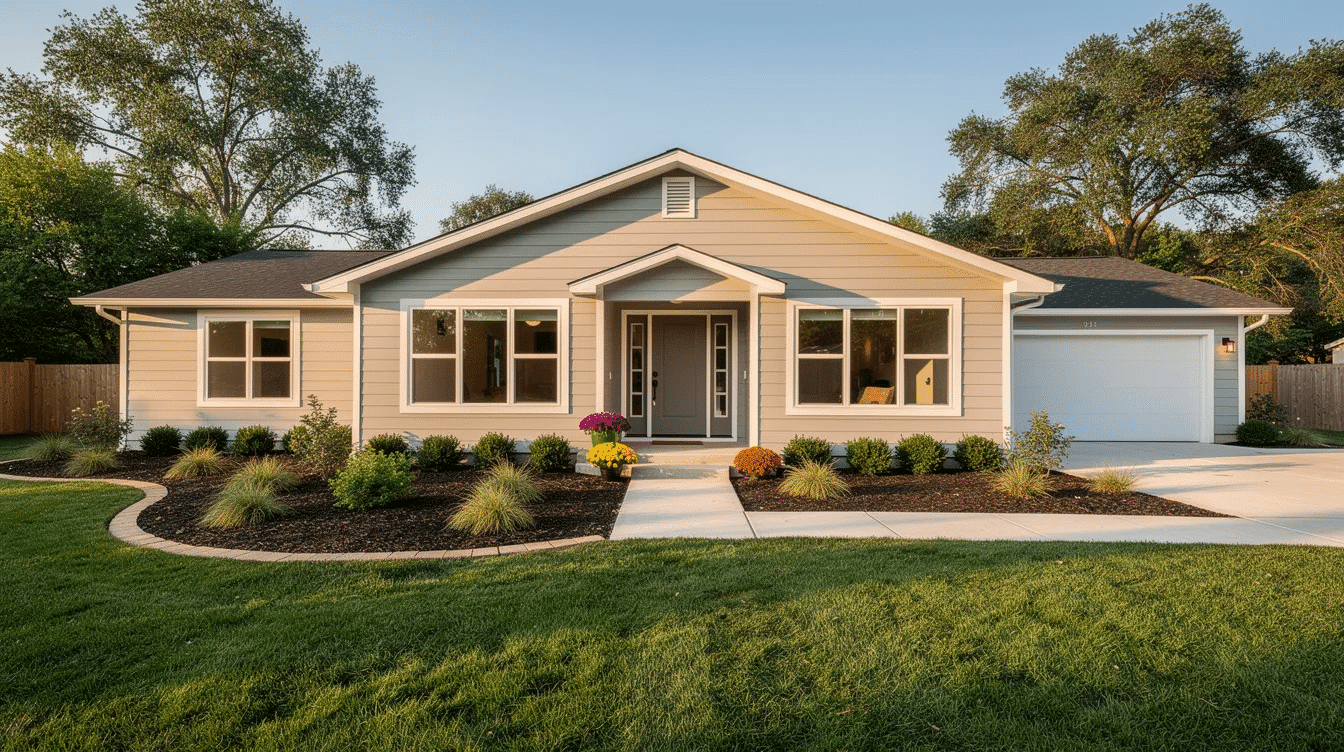
Before you change anything on your home exterior, understand what you’re working with. A 1972 brick ranch built in the Contemporary style will respond differently to updates than a 1978 Rambler with aluminum siding, and both sit within the broader legacy of historic ranch houses in American architecture. Knowing your house’s original intent helps you make changes that feel coherent rather than confused.
Typical 70s Ranch Traits
The ranch style home built during this decade shares common DNA, while still fitting within the broader story of beautiful ranch homes where style meets functionality:
- Rooflines: Low-pitched gable or hip roofs, typically 3:12 to 5:12 slopes
- Footprint: Long rectangular layouts spanning 1,500 to 2,500 square feet
- Garage: Attached one- or two-car garage facing the street (often occupying 30-40% of facade width)
- Exterior materials: Face brick on lower walls in earthy tones—orange-brown, tan, salmon—with aluminum, vinyl, or wood siding above
- Entry: Small stoops rather than full porches, often with narrow porticos
- Trim: Minimal ornamentation reflecting the era’s shift toward economical, Contemporary influences
Confirm Your Build Year
Pull your home’s actual construction date from county assessor records or tax documents. This matters because many 70s ranches received partial updates in the 1980s or 1990s—vinyl siding overlays that hide original materials, replacement windows that don’t match the home’s character, or entry doors that felt modern in 1995 but now read as dated.
Document What You Have
Walk the entire house exterior and photograph:
Element | What to Note |
|---|---|
Windows | Sizes, frame material, grid patterns (6-over-6, horizontal sliders) |
Brick/Siding | Areas of each, colors, condition |
Roof | Material, pitch, condition, remaining lifespan |
Fascia/Soffits | Material, ventilation, rot or damage |
Entry | Stoop size, door style, overhang depth |
Identify whether your ranch house leans Colonial (symmetrical, shutters), Contemporary (clean lines, large glass), Prairie-influenced (horizontal emphasis, deep eaves), or basic Rambler (unadorned efficiency). This guides how modern or classic your update should be. |
Decide on a Direction: Restore 70s Character or Go Modern?
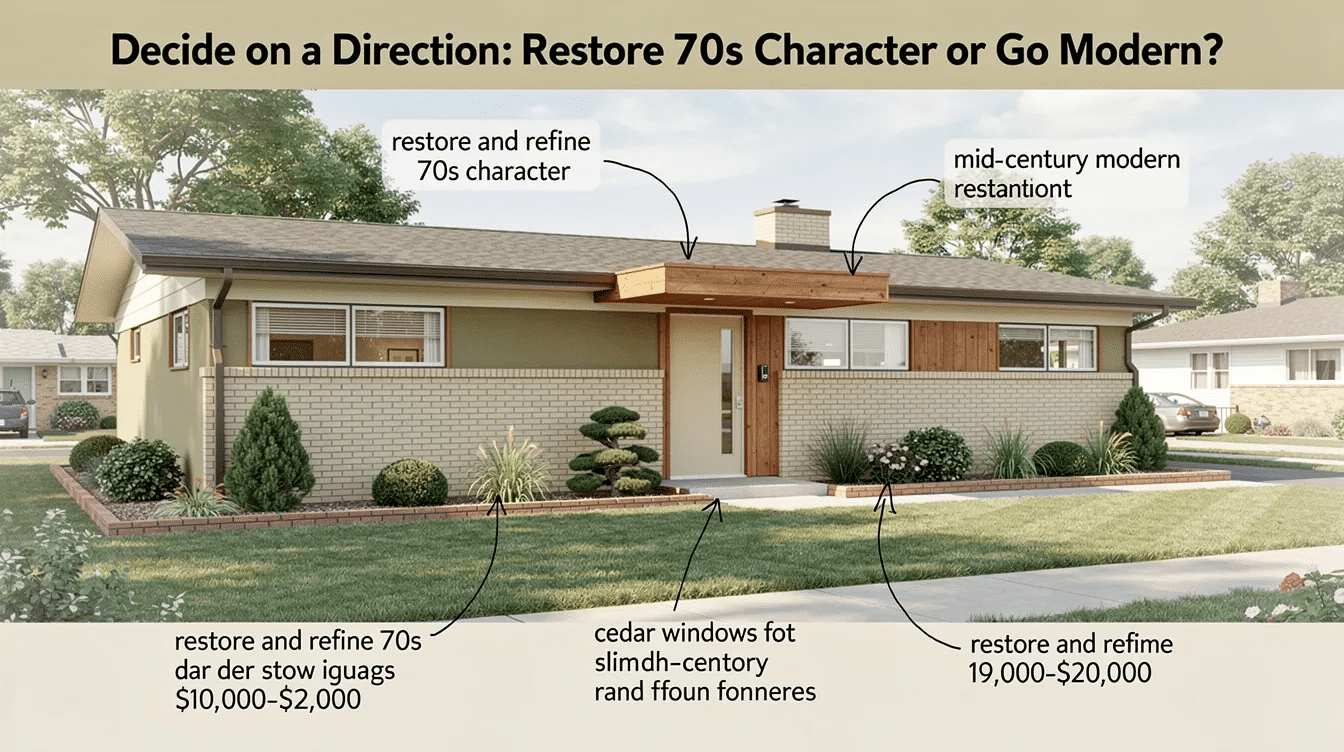
Every ranch remodel faces a fork in the road. You can embrace and refine what the 1970s builders intended, or you can reinterpret the house for 2020s expectations. Both paths work—but mixing them carelessly creates visual confusion.
Path 1: Restore and Refine 70s Character
Restoring authentic 1970s character means emphasizing mid-century modern restraint: clean lines, bold geometric contrasts, and period-appropriate materials like unpainted brick or blonde wood accents, much like thoughtful updates to 1920s ranch houses that preserve their original charm. This approach:
- Keeps costs focused by working with existing rooflines and window openings
- Respects the architecture’s inherent efficiency
- Typically costs 20-30% less than modern transformations
- Works well in neighborhoods with other preserved mid-century homes
A 1978 suburban ranch in Ohio might take this path: retain original slim windows but upgrade to insulated glass, apply warm earth-tone exterior paint, add cedar accent pieces at the entry, and refresh landscaping with period-appropriate plantings. Budget for this approach often lands in the $10,000-$20,000 range for paint and trim refresh.
Path 2: Modern or Farmhouse Reinterpretation
Going modern means painting brick, simplifying trim, removing decorative shutters, and using clean-lined fixtures to transform the house for current buyers, echoing many proven ranch home exterior makeover ideas. A 1974 brick ranch in a Texas suburb might:
- Paint orange-brown brick in a warm white or greige
- Install black-framed energy-efficient windows
- Add a charcoal architectural shingle roof
- Replace the entry door with full-lite glass in a dark stain
This modern look approach can boost curb appeal by 15-25% according to real estate appraisals, but requires larger budgets: $50,000-$150,000 for surface-only work, and $200,000+ if you’re adding porches or altering rooflines.
Budget Reality Check
Update Level | Typical Cost Range | What’s Included |
|---|---|---|
Paint & trim refresh | $10,000-$20,000 | Exterior paint, minor trim updates |
Surface transformation | $50,000-$150,000 | Painted brick, new siding, windows, entry |
Structural changes | $200,000+ | Porch additions, roofline alterations, new addition |
Most homeowners land somewhere in the middle—modernizing key elements while keeping the existing footprint and basic structure intact. |
Lighten and Open: Windows, Doors, and Natural Light
Many 1970s ranches feel dark inside because of low ceilings, deep eaves, and small windows. Original bedroom and kitchen windows often measured just 2×3 feet, with aluminum sliders prone to leaks and drafts. Energy bills in these homes run 30-50% higher than code-compliant construction.
Updating windows and exterior doors drives the most transformative gains in both natural light and energy performance.
Window Replacement Strategy
Prioritize double- or triple-pane vinyl or fiberglass windows with modern thermal performance (U-factor 0.25-0.35, compared to original U-factors of 0.8-1.0). When possible, fit new windows to existing rough openings to avoid the $5,000+ cost per structural header modification on load-bearing brick walls.
High-impact window ideas:
- Widen the main picture window in the living area from 4×5 feet to 6×8 feet
- Convert a small dining room window to a sliding patio door
- Add sidelight windows flanking the front door
- Replace horizontal sliders with casement windows for more natural light and better operation
Enlarging window openings on a 70s brick or block wall requires lintel reinforcements costing $1,500-$3,000 each, plus engineering stamps and permits. Factor this into your project budget before committing to major remodel scope.
Keep Styles Consistent
Window frame finishes should unify the facade:
- Modern direction: Black or bronze aluminum-clad frames
- Traditional/Colonial-leaning: White frames with divided lights
- Mid-century restoration: Slim profiles in dark or natural tones
Inconsistent window styles—mixing black modern frames with white Colonial grids—undermines even expensive updates.
Front Door Transformation
The front door offers the most visible upgrade opportunity. Original 70s doors were often flush blonde wood with gold hardware and small decorative glass. Current options that work well:
- Full-lite glass panels in dark stains or bold colors (navy, brick red, deep green)
- Solid panel doors with modern hardware in oil-rubbed bronze or matte black
- Transoms above the door adding verticality if the porch overhang allows
Adding a glass or full-lite front door from the 1970s footprint forward brightens the entry without altering the structure. Matte black hardware has surged 40% in popularity, reflecting the broader shift toward clean, contemporary finishes.
Updating 70s Ranch Exterior Surfaces: Brick, Siding, and Roof
The biggest visual change on a 1970s ranch comes from how you treat the exterior surfaces together. Brick, siding, and roof create the dominant color and texture story—update them coherently and the house transforms.
Three Approaches to 1970s Brick
Original 70s brick (modular size 3.625×7.625 inches, often wire-cut for texture) can be treated several ways:
Approach | Process | Cost | Lifespan |
|---|---|---|---|
Clean and keep | Pressure wash at 1,500 PSI to remove efflorescence | $0.50-$1.50/sq ft | Indefinite |
Limewash | Breathable mineral paint softens brick porosity | $3-$5/sq ft | 5-10 years |
Full paint | Acrylic latex with masonry primer | $4-$8/sq ft | 10-15 years |
Painting brick painted white or in greige creates dramatic transformation but risks moisture trapping if the paint isn’t breathable. Limewash offers a softened, European aesthetic while allowing the brick to breathe naturally. |
Siding Upgrades
If your ranch has faded aluminum siding (0.032-inch gauge, prone to denting) or deteriorating vinyl from an 80s overlay, consider replacement with:
- Fiber cement (James Hardie): $6-$10/sq ft installed, 5/16-inch thick, excellent durability
- Engineered wood (LP SmartSide): Similar price range, warm appearance
- Board and batten: Works well for modern farmhouse style
- Horizontal lap: Suits traditional ranch proportions
Match siding proportions to your ranch’s 1:4 height-to-width ratio. Vertical board and batten on a long, low ranch can fight the horizontal character if overused.
Roof Updates
Original 3-tab asphalt shingles from the 1970s had 15-20 year lifespans—meaning any original roof is long overdue for replacement. Options include:
- Architectural dimensional shingles: $4-$7/sq ft, 30-50 year lifespan, more visual depth
- Standing seam metal roof: $10-$15/sq ft, reflects 70% of heat in hot climates, modern aesthetic
Darkening the roof profile from brown to charcoal alters perceived mass by 10-15% visually—a charcoal or black roof on a light-painted house creates crisp contrast that reads as intentional and current, similar to the bold curb appeal of a black ranch house with modern exterior design.
Soffits and Fascia
1970s soffits often lack adequate ventilation, contributing to attic moisture problems. Replacement with vented aluminum or PVC (1-inch continuous slots for 1/150 attic ventilation ratio) solves moisture issues while cleaning up the overhang appearance. Smooth 1×6 trim boards replace dated beveled profiles for a sleeker look.
Timeless surface combinations:
- Warm white siding + medium-tone natural brick + charcoal roof
- Greige painted brick + black windows + dark bronze metal roof
- Deep green siding + warm wood accents + charcoal shingles
Modernizing the Entry: Porches, Steps, and Front Doors
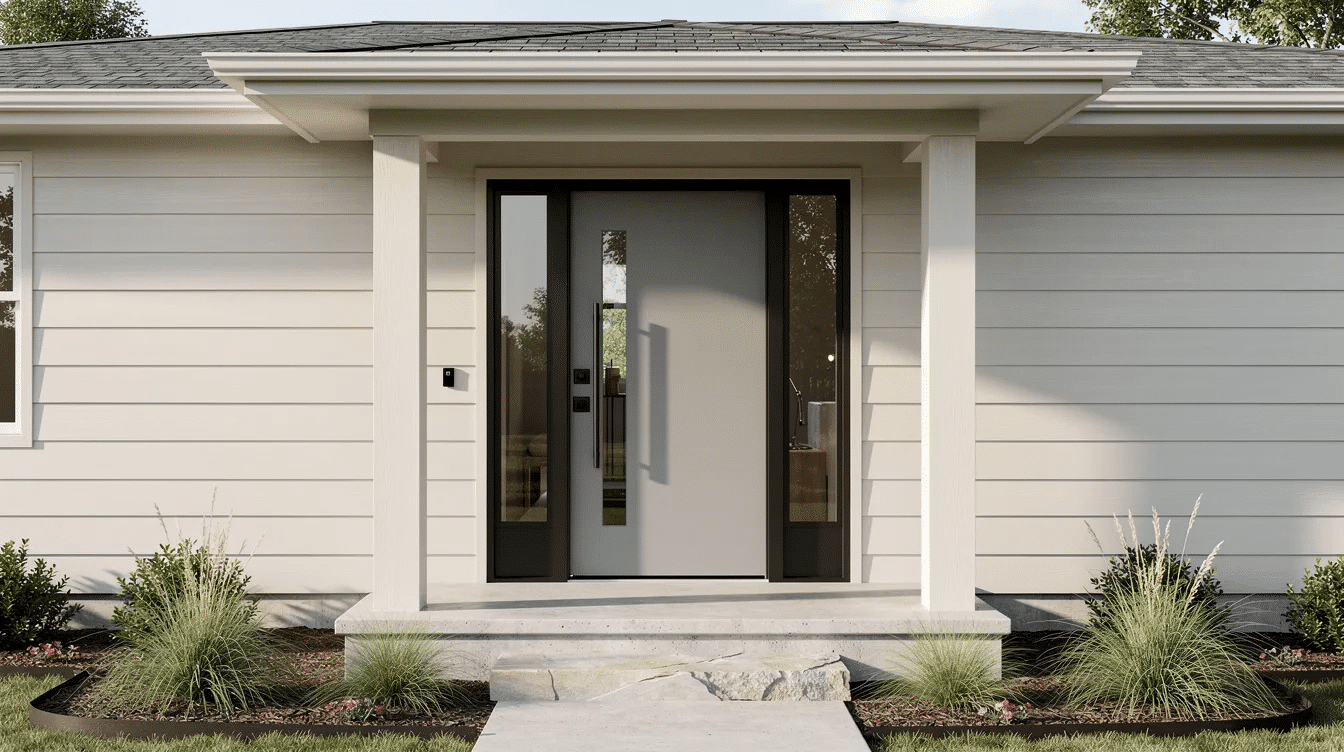
The main entrance is the focal point of any ranch remodel. Unfortunately, 1970s ranch entries were often afterthoughts—small concrete stoops raised 2-3 feet, metal railings, narrow roof overhangs, and flush doors that communicated nothing about the home’s interior.
Common 1970s Entry Problems
- Stoops too small for any furniture (often 4×6 feet)
- Ornate iron railings that fight clean ranch lines
- Storm doors obscuring entry appearance
- Minimal lighting creating unwelcoming approaches
- Overhangs too shallow to provide weather protection
Expanding the Stoop
Converting a bulky concrete stoop to a grade-level entry with pavers or stamped concrete immediately modernizes the approach. Extend to 8×10 feet minimum to accommodate a bench or chairs, creating a comfortable space that invites visitors to linger.
Entry surface options:
- Tumbled-edge quartzite pavers mitered at corners ($15-$25/sq ft)
- Stamped concrete in slate or flagstone patterns
- Simple poured concrete with exposed aggregate
For porch additions, use simple 4×4 or wrapped 6×6 wood columns stained cedar rather than ornate iron. The goal is supporting the ranch style’s inherent simplicity, not fighting it with decorative excess.
Front Door Selection
Your front door should make a statement consistent with your chosen style direction:
- Modern: Full-lite glass panels, matte black hardware, deep navy or charcoal paint
- Farmhouse: Divided-light glass, oil-rubbed bronze hardware, natural wood stain
- Mid-century: Solid panel in warm earth tones, minimal hardware, geometric details
Modern house numbers (4-inch modern fonts work well) and matching hardware complete the personal style statement.
Entry Lighting and Path
Integrate path and step lighting along the walk from driveway to door. LED bollards at 3000K color temperature guide visitors while enhancing perceived welcoming scale by 25%. Matched wall sconces flanking the door—matte black for modern, brushed nickel for transitional—tie the lighting story together.
Garage, Driveway, and Curb Appeal Details
Front-facing garages dominate most 1970s ranch facades, often occupying 30-40% of the total width. Ignoring the garage while updating everything else creates obvious imbalance.
Garage Door Updates
Replace paneled steel doors with styles that integrate with your overall design:
Style Direction | Garage Door Choice |
|---|---|
Modern | Flush panel, minimal texture, dark color |
Farmhouse | Carriage-style with X-pattern, wood-grain finish |
Mid-century | Simple horizontal panels, natural wood or warm tone |
Budget $2,000-$4,000 per door for quality options that match entry trim and color scheme. |
Breaking Up the Facade
Add a simple trim detail or small overhang (12-18 inches) above the garage door to visually connect it with the main entrance. This breaks up the long facade and creates intentional architectural rhythm rather than competing masses.
Driveway Improvements
1970s driveways were often narrow concrete strips adequate for era vehicles but cramped for modern SUVs. Options include:
- Widening with matching concrete or pavers
- Adding paver borders at edges for visual interest
- Scoring and staining existing slabs ($3-$5/sq ft) for updated appearance
- Replacing damaged sections rather than entire house approach
Screening the Garage
Downplay large garage mass with layered landscaping between curb and garage: ornamental grasses, mid-height shrubs (Indian hawthorn at 4-6 feet works well), or a small accent tree positioned to break sightlines without blocking views.
Small Details That Matter
Consistent finishes throughout the facade communicate intentionality:
- Matching mailbox and house numbers in the same metal finish
- Porch sconces and garage sconces in coordinating styles
- Address plaques that complement door hardware
These accent pieces cost relatively little but signal that someone thought about the whole composition.
Landscaping to Complement a 1970s Ranch Exterior
Landscape changes can do as much as paint to modernize a 70s ranch. The challenge: designing plantings that complement the long, horizontal house form without overwhelming low windows or competing with architectural updates.
Front-Yard Layouts for Ranch Forms
Effective ranch landscaping emphasizes horizontal layers that echo the house’s profile:
- Groundcover layer: Liriope, mondo grass, or low sedums
- Mid-shrub layer: Structured boxwood, dwarf varieties of traditional foundation plants
- Accent tree layer: Small magnolias, crepe myrtles, or Japanese maples positioned to frame rather than overwhelm
Sweeping curved walkways (6-foot width minimum) create graceful approaches that suit the ranch’s relaxed character better than rigid straight paths.
Replacing Overgrown Foundation Shrubs
Original 1970s landscaping often featured yews, junipers, or holly that have grown to block 50% of windows and obscure brick details. Replace with lower, more structured plantings:
- Keep mature shrub height below window sills
- Space plants to allow individual form visibility
- Use repetition for cohesive rather than chaotic appearance
Regional and Sustainable Choices
Current landscaping reflects 2020s sustainability priorities, with 60% of new landscapes incorporating native plants:
- Midwest: Switchgrass, coneflowers, native sedges
- Southwest: Agave in gravel mulch, desert marigold, yucca
- Southeast: Muhly grass, native azaleas, ferns
Smart irrigation controllers reduce water use 30% compared to traditional timer systems—a practical upgrade that supports updated plantings.
Focal Elements
Add one or two elements that create visual interest without cluttering:
- 1970s-inspired concrete planters (echoing the era’s Brutalism) with seasonal plantings
- Simple modern pergola over a seating pad near the entry
- Low seat wall in materials matching the home’s updated palette
Supporting Infrastructure
Don’t let a refreshed exterior sit in a visibly “1975” yard. Upgrade:
- Irrigation from spray heads to drip where appropriate
- Edging from plastic strips to steel or aluminum
- Mulch from red-dyed bark to natural wood or gravel appropriate to style
Case Study 1: Before & After of a 1974 Brick Ranch Exterior
A 1974 brick ranch house in suburban Atlanta represented a common challenge: solid bones, dated skin. The family had lived there for years ago but increasingly felt embarrassed by the curb appeal compared to remodeled neighbors.
Before
The exterior featured classic 70s problems:
- Orange-brown brick in excellent structural condition but deeply unfashionable color
- Dark brown painted trim and fascia
- Narrow aluminum horizontal slider windows with visible oxidation
- Original 3-tab shingle roof showing wear after 22 years
- Tiny 4×6-foot concrete stoop with wrought iron railings
- Overgrown foundation shrubs blocking lower windows
After
The transformation focused on surfaces and entry:
- Brick painted Sherwin-Williams Pure White using breathable masonry paint
- All exterior trim updated to charcoal
- Black-framed energy-efficient windows sized to fit existing openings
- Architectural shingle roof in Charcoal Black
- Wood front door with three-quarter glass panel, stained walnut
- Modern black wall sconces flanking entry
- Stoop expanded to 8×10 feet with bluestone pavers
- Foundation plantings replaced with layered boxwood and ornamental grasses
Scope and Timeline
Exterior updates completed over one summer season with work sequenced logically: roof replacement first (two weeks), then windows (one week), then painting (three weeks), then entry and landscaping (two weeks).
The transformation shifted neighborhood perception immediately. Real estate agents noted the home would now command attention from 2020s buyers seeking that modern look while retaining single story home accessibility that empty nesters and young families both value.
Case Study 2: Updating a 1978 Ranch to Modern Farmhouse Style
A 1978 siding-and-brick ranch on a larger Colorado lot offered different opportunities. The owners wanted the warmth of modern farmhouse exterior design while keeping their single-level living arrangement intact.
Before
The house presented as forgettable:
- Faded beige vinyl siding from a 1990s overlay
- Brown non-functional shutters screwed directly to siding
- Basic white steel garage door with no architectural detail
- Unremarkable front entry with aluminum storm door
- Concrete path cracking from freeze-thaw cycles
- Overgrown grass lawn with no defined beds
After
The transformation embraced farmhouse vocabulary while respecting ranch proportions:
- New vertical board and batten fiber cement on the front gable section
- Existing brick cleaned and painted in complementary warm gray
- Black standing seam metal roof on the extended porch (asphalt architectural on main roof)
- Stained cedar 6×6 posts supporting new 6-foot-deep covered porch
- Black divided-light windows with applied exterior grids
- Carriage-style garage door with X-patterns matching porch details
- Modern barn-style pendant lighting at entry
- Gravel and flagstone walkway from driveway to porch with steel edging
- Native grass plantings and concrete counter stools near the entry seating area
Finishing Touches
The extended porch created room for a wooden swing and rocking chairs, delivering the farmhouse welcome the owners wanted. Interior design updates to the visible living area through new windows completed the cohesive story.
Total ranch remodel budget including modest interior updates landed near $400,000—significant investment, but the home transformed from unremarkable to destination in a neighborhood of otherwise similar ranches.
Common Mistakes When Updating a 70s Ranch Exterior
Over-decorating or mixing too many styles can backfire on a simple 1970s ranch form. The architecture succeeds through restraint—fighting that character rarely works.
Style Incompatibility
Combining elements from different architectural vocabularies creates confusion:
- Heavy “French country” stone cladding on a basic Rambler ranch footprint
- Ultra-modern black metal windows paired with Colonial shutters
- Mediterranean tile roofs on a Contemporary ranch
- Craftsman-style columns supporting a minimal mid-century overhang
Choose one direction and commit. The ranch’s simplicity requires consistent vocabulary.
Ignoring Proportions
Adding steep gables or tall entry towers fights the low, linear character that defines ranch style:
- Original rooflines typically run 3:12 to 5:12—new elements should match
- Deep eaves (18-24 inch projections) are features, not problems to eliminate
- Vertical additions disrupt horizontal emphasis
If you want a two-story house, the ranch form may not be your starting point. Work with the low ceilings and horizontal emphasis rather than against them, and consider whether subtle additions like stylish dormers on a ranch house make sense for your roofline and budget.
Climate-Inappropriate Choices
Some trendy decisions don’t survive local conditions:
- Solid black paint in desert sun loses 20% pigmentation within 3 years without anti-fade primers
- Dark colors absorb heat problematically in already-warm climates
- Materials that perform well in mild regions may fail in freeze-thaw cycles
Research paint colors and materials appropriate to your local materials and climate before committing.
Cheap Add-Ons
Budget constraints tempt homeowners toward thin fixes that read as exactly that:
- Decorative vents that serve no function
- Faux shutters sized incorrectly for windows (and screwed flat to walls)
- Multiple mismatched light fixtures
- Peel-and-stick stone veneer
Focus budget on fewer, higher-quality changes: replace existing ones that matter most (windows, doors, main cladding) rather than adding decorative elements that dilute intentionality.
Piecemeal Execution
Weekend-project mentality often produces incoherent results. A new front door this year, painted shutters next year, different-colored trim the year after—each reasonable alone, collectively chaotic.
Plan the whole composition before executing any piece.
Planning, Budgeting, and Working with Pros on a 70s Ranch Remodel
Successful 70s ranch exterior updates follow logical sequences rather than random opportunities. Map out a phased plan before picking up a paintbrush.
Planning Order
Work through updates in this sequence:
- Define style direction: Modern, farmhouse, mid-century, or refined traditional
- Address roof and structural issues: Roof replacement ($15,000-$30,000 average), structural repairs, water damage remediation
- Windows and exterior doors: Replace or upgrade openings ($20,000-$50,000)
- Surfaces: Brick treatment, new siding, paint ($30,000-$60,000)
- Entry updates: Porch expansion, steps, door, lighting
- Landscaping: Foundation beds, walkways, irrigation ($10,000-$25,000)
This sequence prevents rework—you don’t want to paint siding before addressing roof issues that might damage new surfaces.
Working with Professionals
For surface-only updates, capable DIYers with time can handle paint, simple landscaping, and fixture replacement. Structural changes require professionals:
- Design-build contractors: Handle permits, coordinate trades, provide bulk material pricing (often 20% savings)
- Exterior designers: Help develop coherent vision before construction begins
- Structural engineers: Required for window enlargements in load-bearing walls, porch additions, roofline modifications
70% of structural modifications in post-1980s HOA communities require permits and design review. Check local requirements early.
Budget Ranges
Scope | Budget Range | Includes |
|---|---|---|
Cosmetic refresh | $15,000-$35,000 | Paint, lighting, landscaping, front door |
Surface transformation | $50,000-$150,000 | Above plus windows, siding/brick treatment, roof |
Major remodel | $150,000-$300,000 | Above plus porch additions, structural changes |
Addition/expansion | $300,000+ | New square footage, second-story pop-tops |
Preserve What Works
The best 70s ranch updates enhance rather than erase the form’s inherent strengths:
- Single-level accessibility appeals to families and empty nesters alike
- Generous lot sizes accommodate outdoor living impossible on newer, denser lots
- Simple forms accept various style interpretations
- Solid construction outlasts trendy tract homes
Your 1970s ranch house has survived five decades. With thoughtful exterior updates and inspiration from ranch homes that redefine comfort and style, it’s positioned for five more—looking better than it ever did.
Ready to start? Document your home’s current condition with photos, define your style direction, and outline a phased plan that addresses highest-impact changes first. The ranch home you drive up to tomorrow could look dramatically different by next summer—without touching the functional floor plan inside or expanding beyond your existing footprint.
The ideas presented here work whether you’re creating a forever home or preparing for sale. Either way, that solid 1970s structure deserves an exterior that finally does it justice, just as many enthusiasts of ranch style homes across the USA are rediscovering.