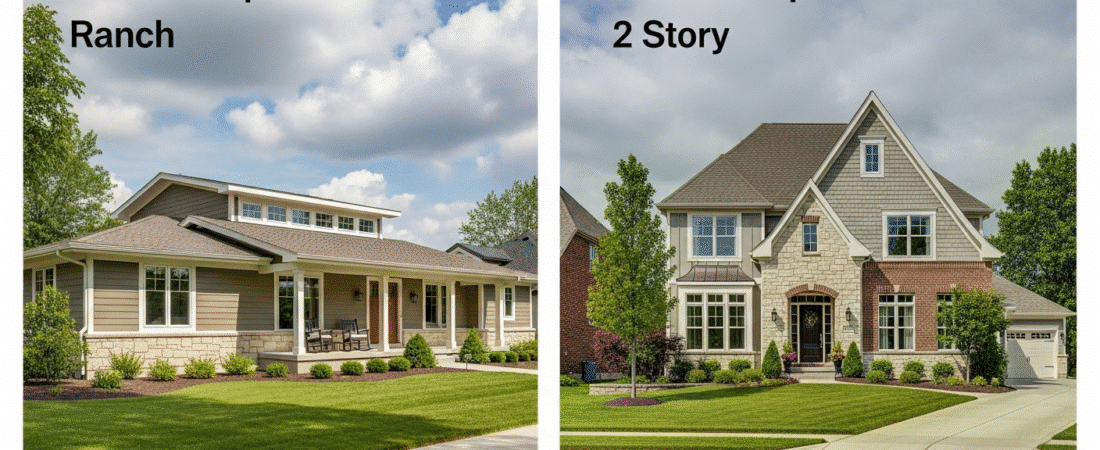

When you’re thinking about building a house, the cost per square foot ranch vs 2 story is one of the first big questions that pops up. I’ve been there, staring at blueprints and spreadsheets, trying to figure out which style gives you more bang for your buck. Two-story homes are often cheaper to build per square foot, making them an attractive option for many homeowners. It’s a huge decision that impacts not just your wallet upfront, but your life in the home for years. Do you want everything on one level, or are you cool with stairs? Let’s break it down together.
TL;DR Summary
- Two-Story Homes: Generally cheaper per square foot to build. They have a smaller foundation and roof, which saves on major material costs. Best for smaller lots.
- Ranch Homes: Often more expensive per square foot. They need a larger foundation and roof. Perfect if you have a big piece of land and want everything on one floor.
- Key Factors: Land cost, foundation size, roofing, and labor all play a big part in the final price tag.
- Long-Term Costs: Two-story homes can be a bit more energy-efficient, saving you money on heating and cooling over time.
Construction Costs and Getting More for Your Money
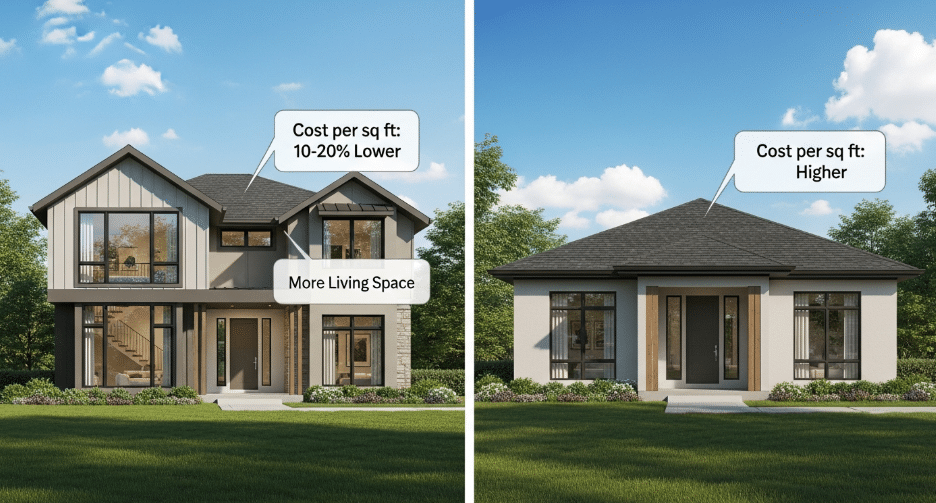
When you get quotes from builders, you’ll probably notice a pattern. The cost per square foot for a two-story home is usually a little lower. Think of it like this: building up is often cheaper than building out. Two-story homes offer potential savings of 10-20% per square foot over ranch designs, making them an attractive option for budget-conscious homeowners.
Why Two-Story Homes Can Be Cheaper
Two-story homes have a smaller footprint. This means you need less concrete for the foundation and fewer materials for the roof. Since the foundation and roof are two of the most expensive parts of a build, shrinking them makes a real difference. Roofing costs can be especially significant, as a larger roof area on a ranch home increases expenses for both labor and materials. The larger footprint of ranch homes necessitates a larger roof area, adding significantly to overall costs. The choice of roofing material, such as metal, can further impact total roofing costs, with options like fascia and soffits adding to the overall price—especially for expansive ranch or large multi-story designs.
Let’s look at a simple example. Imagine you want a 2,000-square-foot house.
| Home Type | Dimensions (Example) | Foundation/Roof Area |
|---|---|---|
| Ranch | 40 ft x 50 ft | 2,000 sq ft |
| Two-Story | 25 ft x 40 ft (per floor) | 1,000 sq ft |
As you can see, the two-story home’s foundation and roof are half the size of the ranch’s. That’s a huge saving on materials and labor right there. Plumbing and wiring can also be more direct in a two-story house, since you can stack bathrooms and kitchens.
Typically, ranch homes cost between $150-$200 per square foot to build in 2025, while two-story homes generally cost between $130-$180 per square foot. For example, a 3,000 square foot ranch might cost $450,000-$600,000 to build, while a comparable two-story home might run $390,000-$540,000.
Of course, building up isn’t without its own costs. You’ll need stairs, and the structure has to be stronger to support a second level. Sometimes, getting materials up to the second floor can add a bit to labor costs, but it usually doesn’t outweigh the savings from the smaller foundation and roof.
“A smaller foundation and roof are the biggest cost-savers for a two-story build. It’s simple math—less area means fewer materials and less labor.” – A local builder I chatted with last week.
Land Size: How Much Space Do You Need?
The house itself is only part of the equation. You also need a place to put it! The cost of land can be a massive part of your total budget, especially if you’re building near a city. The value and potential of the ground, as well as the location, can significantly impact your total project costs and design choices, since construction costs, style preferences, and even climate can vary by region.
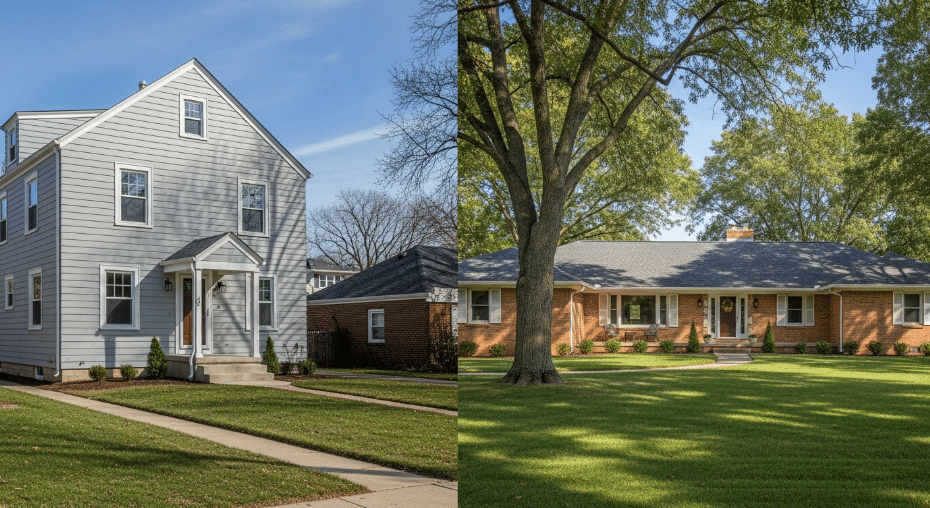
A two-story home is a clear winner if you’re working with a smaller or more expensive lot. Since it has a smaller footprint, you can fit the same amount of living space on less land. For example, a comparable 2,000 square foot two-story home might require only 5,500-7,000 square feet of land. This makes two-story homes more land-efficient, leaving you with more yard for the kids to play in or for a garden. If you’re building in a new subdivision where lots are narrow, a two-story might be your only option.
Ranch homes, on the other hand, are made for larger lots and have a larger footprint, meaning they require more land to accommodate the same square footage. For a 2,000 square foot ranch home, a minimum lot size of 8,500-10,000 square feet is typically needed. Ranch homes are ideal for larger lots as they utilize more of the available land compared to two-story homes. They sprawl out, which is great if you have the space and want a big, connected feel. I’ve always loved the look of a long ranch house sitting on a few acres. It just feels classic. If land is cheap where you are, the extra cost of a ranch’s footprint might not be a big deal, but keep in mind that the land requirements for ranch homes are typically larger than for two-story homes, which can significantly affect total project costs. Ranch-style homes also require more foundation and excavation work than two-story homes to achieve the same total square footage.
Design and How You’ll Live in the Space
This is where personal preference really comes into play. How do you and your family actually want to live? The number and arrangement of rooms, as well as whether you prefer open concepts or more defined spaces, can greatly influence the feel and function of each home style.
Ranch homes naturally support open concepts, making it easy to create spacious, flowing living areas. They also allow for more customization flexibility because they do not require support walls like two-story designs. The single-level layout of ranch homes offers accessibility benefits for families with young children and older adults, provides a quieter living environment since there are no upstairs neighbors, and is often considered more suitable for aging in place.
Two-Story Living
Two-story homes offer a natural separation of space, which is especially beneficial for families with children or guests. You can have all the bedrooms upstairs, keeping the downstairs for living and entertaining. This layout allows for the owner suite to be separated from secondary bedrooms, helping to reduce noise from activities like loud music and improving sleep quality at night. It also gives you more options for privacy. A bonus room over the garage can become a perfect home office, gym, or playroom.
The main downside? Stairs. They can be a pain, especially as you get older or if you have family members with mobility issues. Getting an open-concept feel can also be trickier because of the load-bearing walls needed to support the second floor.
Ranch Living
I have to admit, the idea of having everything on one level is pretty appealing. No more running up and down stairs for a forgotten glass of water. Ranch homes are ideal for empty nesters because the lack of stairs makes daily living more convenient and accessible, and they are also perfect for families with young kids since the single-level design is safer and more manageable for little ones. Ranch homes are perfect for young families with little kids (no worrying about tumbles down the stairs) and for people planning to age in place.
They are also super easy to design with an open concept. You can have the kitchen, dining room, and living room all flow together in one big, welcoming space. If you want to add a basement, it’s often easier to integrate it into a ranch design. The main drawback is that bedrooms are often right next to the main living areas, which can mean less privacy and more noise.
Keeping Your Home Warm and Cool
Thinking about long-term bills is just as important as the initial building cost. How much will it cost to heat and cool your new home every month?
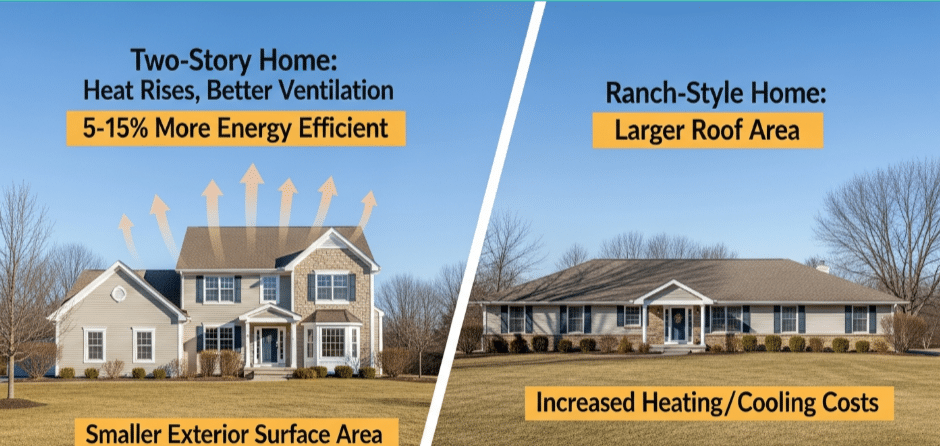
Generally, two-story homes are more energy-efficient. Heat rises, which is a big help in the winter. The heat from the first floor naturally travels up to help warm the second. In the summer, the “stack effect” helps with ventilation. Because the floors are stacked, there’s less exterior wall and roof surface area exposed to the sun and cold. This can lead to some real savings on your utility bills, maybe even 5-15% a year. In most climate zones, two-story homes tend to be 5-15% more energy-efficient overall compared to ranch homes.
Ranch homes have a huge roof, which can be a major source of heat loss in the winter and heat gain in the summer. You’ll need to pay extra attention to insulation in the attic to keep your costs down. That said, with modern building materials and smart design, you can make any home energy-efficient. It might just cost a little more to get a ranch to the same level as a two-story.
What Your Neighbors Are Building
Where you live matters. Location plays a major role in determining the cost gap between ranch and two-story homes, as local land prices and construction costs can vary widely. Building costs can change a lot from one state to another, or even from one city to the next. In some areas, the cost difference between a ranch and a two-story might be small. In others, it could be huge.
Your local climate also plays a role. In a cold climate, the energy efficiency of a two-story home is a bigger selling point. In a hot climate, the large roof of a ranch could be a place to put a ton of solar panels.
It’s also a good idea to look at what’s popular in your area. If everyone is building two-story homes, there might be a good reason for it. It could also affect your home’s resale value down the road. Building a home that fits in with the neighborhood is usually a safe bet.
Popular Home Sizes and Cost Implications
When you’re planning your dream home, the size you choose has a cracking impact on your budget—especially when you’re comparing a one story house to a two story house. Its dead simple really: the cost per square foot can shift quite a bit depending on whether you’re knocking up a ranch or a two story home, even if both have got the same total square footage.
Let’s say you’re looking at a 2,000 square foot house. With a two story design, you can pop all that living space into a smaller footprint, which means you’ll need less foundation and a smaller roof area. That’s where the savings start to add up in a big way. For example, a 2,000 square foot two story house might only need a 1,000 square foot foundation and roof, while a one story house with the same square footage would need double that. Since foundation and roofing are two of the biggest line items in your construction budget, this difference can make a two story home way more cost effective per square foot—its a right clever way to get more bang for your buck.
This pattern holds true for other popular home sizes, too. Whether you’re knocking up a cozy 1,500 square foot story house or a spacious 2,500 square foot family home, the two story option usually keeps foundation and roof costs lower per square. Of course, the final cost will depend on your specific situation, but if you’re looking to maximize your living space without stretching your budget, a two story house often gives you loads more space for less money per square foot—which is a cracking deal any way you look at it.
Understanding how the foundation and roof area affect your overall cost can help you decide which style makes the most sense for your needs—and your wallet. Its dead simple when you break it down like this, and you’ll be well chuffed with the savings you can make by going up instead of out.
Making the Final Call
So, which one is right for you? It’s not just about the numbers. It’s about balancing your budget, your land, and your lifestyle.
Think about your life right now and what you might need in the future. Are you planning on having kids? Do you have older parents who might come to live with you? Do you dream of a huge backyard, or is a small, low-maintenance one just fine?
My advice is to talk to a few local builders. Get some real quotes for both a ranch and a two-story home with the square footage you want. Look at floor plans. Walk through some model homes. Once you see how the costs and the layouts work in the real world, the right choice for you and your family will become a lot clearer.
