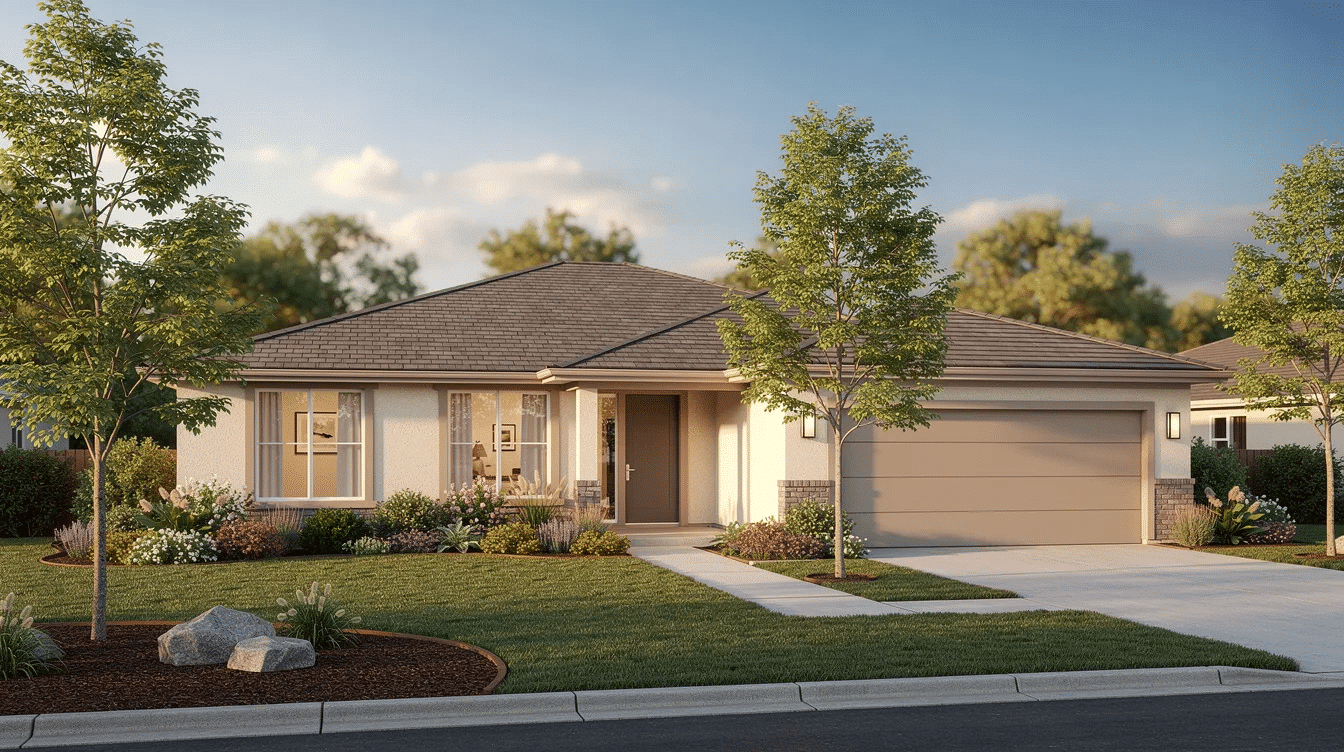
The hip roof ranch house combines two of the most enduring elements in American residential design: a single-story footprint built for efficient living and a four-sided sloping roof that delivers both beauty and structural strength. Ranch-style homes are traditionally one-story houses characterized by their simple, streamlined design, often featuring low, straight rooflines or shallow-pitched hip roofs. The design of hip roofs offers a compact, modern look that complements the aesthetics of ranch-style homes. This home style has remained a staple in suburban neighborhoods since the late 1950s, and it continues to inspire new builds and renovations in 2026. If you’re searching for ranch house plans that balance curb appeal with practical living, this guide will help you learn everything from exterior features to interior layouts and structural considerations.
Below, you’ll find a list of features and characteristics that define hip roof ranch houses, providing an organized overview for potential buyers or builders. Modern ranch house plans often include open layouts, luxurious main bedrooms, large kitchens with islands, and private offices, catering to contemporary living needs. Ranch-style homes typically feature an attached garage and are often constructed with brick or vinyl siding, enhancing their durability and aesthetic appeal.
- Quick Overview of a Hip Roof Ranch House
- Defining the Hip Roof Ranch Style
- Key Exterior Features of Hip Roof Ranch Houses
- Interior Layout and Floor Plan Characteristics
- Design Ideas and Variations for Hip Roof Ranch Homes
- Structural Considerations: Roof, Loads, and Renovations
- Benefits of Ranch House Living
- Landscaping and Outdoor Spaces
- Budgeting and Cost Considerations
- Pros and Cons of Hip Roof Ranch Houses
- Planning, Customizing, and Finding a Hip Roof Ranch Plan
- Finalizing Your Hip Roof Home
Quick Overview of a Hip Roof Ranch House
A hip roof ranch house is defined by its elongated, horizontal profile and a roof where all four sides slope downward toward the walls. Unlike gable roofs with their vertical end walls, the hip roof creates a unified, wraparound appearance that makes the home look grounded and stable from every angle.
The ranch house itself emerged as the ideal family home for post-war America. Its single-story layout eliminates stairs, creating easy circulation for families with children and older adults alike. The floor plan typically spreads rooms along a long axis, placing living spaces toward the front and bedrooms toward the rear or along one wing.
Three key benefits stand out immediately. First, hip roofs offer superior wind resistance—they’re the preferred choice in hurricane-prone coastal regions because the angled surfaces reduce uplift forces. Second, the style delivers strong curb appeal through clean lines and symmetrical proportions. Third, single-level living supports aging in place without mobility barriers.
Hip roof ranches became especially common in U.S. suburbs built from the late 1950s through the 1980s. Many tract developments featured this design as the default, and builders continue to offer it in contemporary subdivisions today.
Defining the Hip Roof Ranch Style
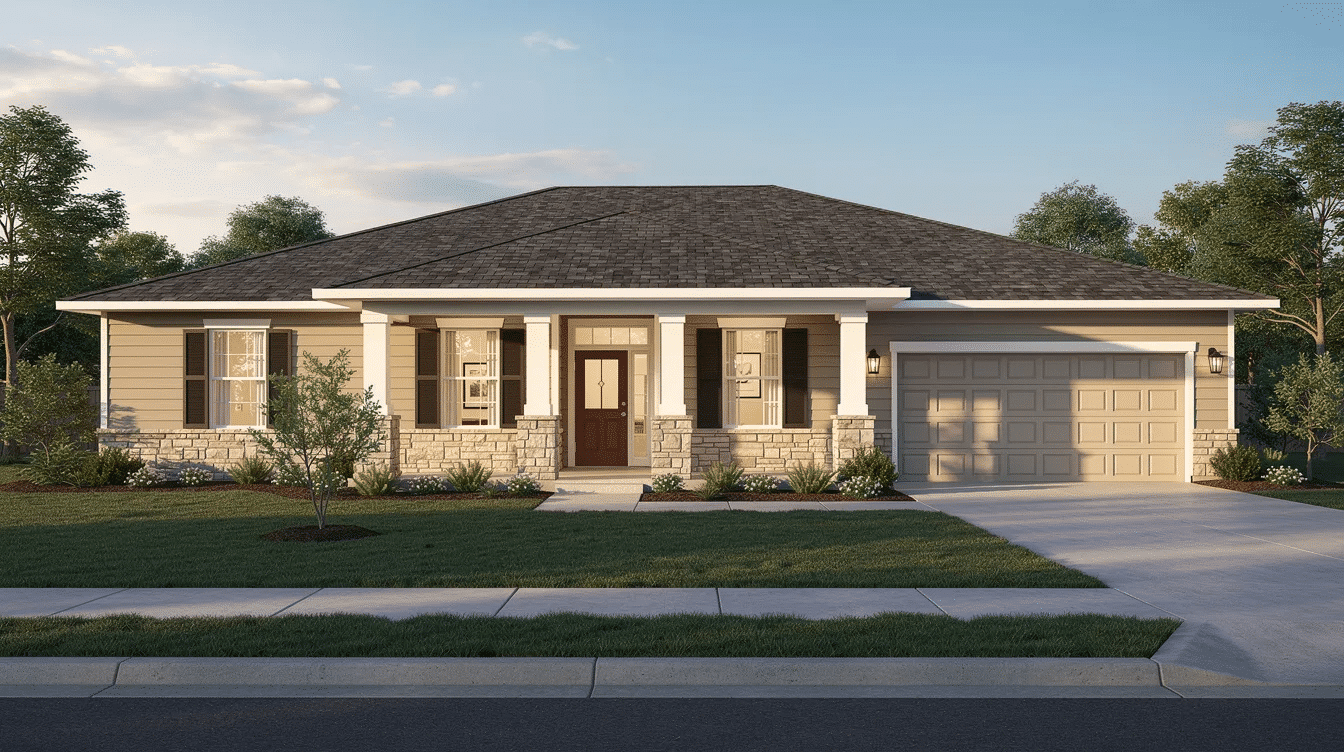
The hip roof ranch represents a deliberate marriage of form and function. Picture a one-story home with a broad, horizontal profile topped by a low-pitched roof that slopes inward from all four sides. The ridge runs along the center, and hip rafters extend diagonally from each corner to meet it. Due to these inward slopes, hip roofs can limit usable attic space, making them less favorable for future attic conversions.
Typical proportions include wide eaves that wrap around the entire perimeter, often extending 12 to 24 inches beyond the wall. Roof pitches generally fall between 3:12 and 5:12—shallow enough to maintain the low profile that defines ranch aesthetics, yet steep enough to shed water effectively. A 1,600 square foot Midwestern ranch built in 1974 might feature a 4:12 pitch with 18-inch eaves, creating that characteristic settled appearance.
Exterior materials evolved across construction periods. Homes built in the 1960s and early 1970s predominantly featured brick veneer, which offered durability and minimal maintenance. By the 1990s and 2000s, vinyl siding became the go-to choice for remodels and new construction in many regions. Contemporary builds after 2015 increasingly incorporate mixed materials—stone accents paired with stucco or fiber-cement boards—to create more visually complex facades, inspiring many homeowners to explore ranch home exterior makeover ideas that update curb appeal without losing the home’s character.
The hip roof visually anchors the house to its site. Compared to a gable-roof ranch, a hip roof design appears broader and more substantial, creating a sense of permanence that many homebuyers find appealing. Insurers often provide lower rates for homes with hip roofs due to their superior wind resistance and structural integrity. Additionally, ranch house plans are available in a range of sizes, including smaller, compact, and efficient designs that are ideal for smaller families or modest lot sizes, optimizing space without sacrificing style or functionality.
Key Exterior Features of Hip Roof Ranch Houses
The exterior of a hip roof ranch house tells a story through its roof structure, facade layout, and material choices. Understanding these features helps you evaluate existing homes or plan new construction with confidence.
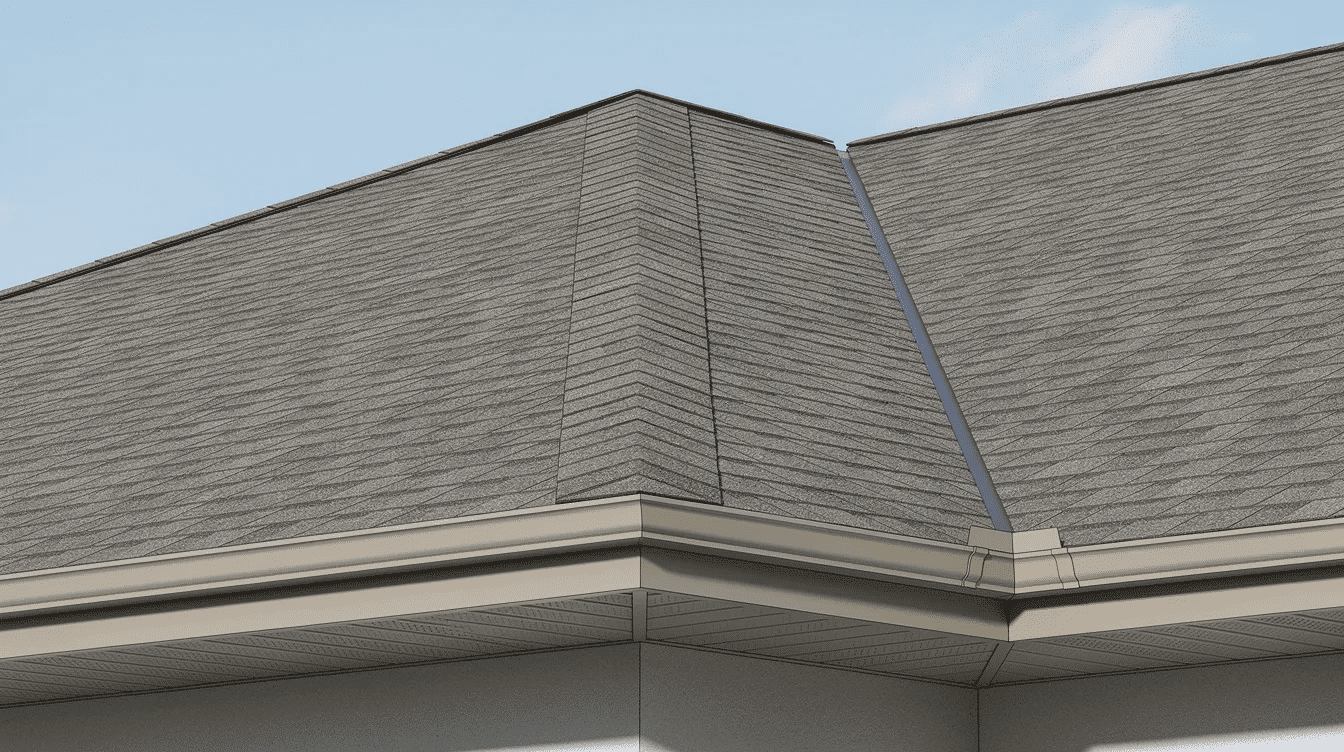
The hip roof structure consists of four sloping planes that converge at a central ridge. Hip rafters form the diagonal edges where two roof faces meet, while common rafters run from the ridge down to the eaves. Jack rafters fill in the triangular sections near the corners. This framing system distributes loads evenly across all exterior walls, contributing to the roof’s structural stability.
Roof materials vary by region and era. Post-1960 suburban ranches typically feature asphalt shingles—affordable, widely available, and adequate for moderate climates. In hotter, drier regions like Arizona and Nevada, concrete tile roofing became more prevalent due to its superior heat reflection. Energy-efficient builds constructed after 2010 increasingly use metal roofing, which offers longevity, wind resistance, and reflective properties that reduce cooling costs.
Facade layouts on hip roof ranches follow efficiency-driven principles. Attached garages sit either perpendicular to the front wall (side-entry) or aligned with it. Low porch roofs blend seamlessly into the main hip structure, and wide front steps create a welcoming entry. The door placement typically sits near the center or slightly offset, depending on the floor plan configuration.
Window patterns emphasize horizontal proportions. Large picture windows in living rooms bring in natural light while reinforcing the home’s linear aesthetic. Windows are often lined along the main walls or openings, enhancing both the visual appeal and organization of the interior spaces. Sliding glass doors leading to rear patios emerged as standard features on homes built after about 1980, connecting interior spaces to outdoor living areas. Some modern designs incorporate clerestory windows positioned under the eaves to introduce indirect light without sacrificing wall space.
Trim and material details reflect both period and style. White vinyl trim creates crisp lines against brick or siding on suburban tract homes. Transitional farm-ranch hybrids built in the 2020s increasingly feature dark-stained timber accents or board-and-batten siding details for a more rustic, country-inspired look.
Interior Layout and Floor Plan Characteristics
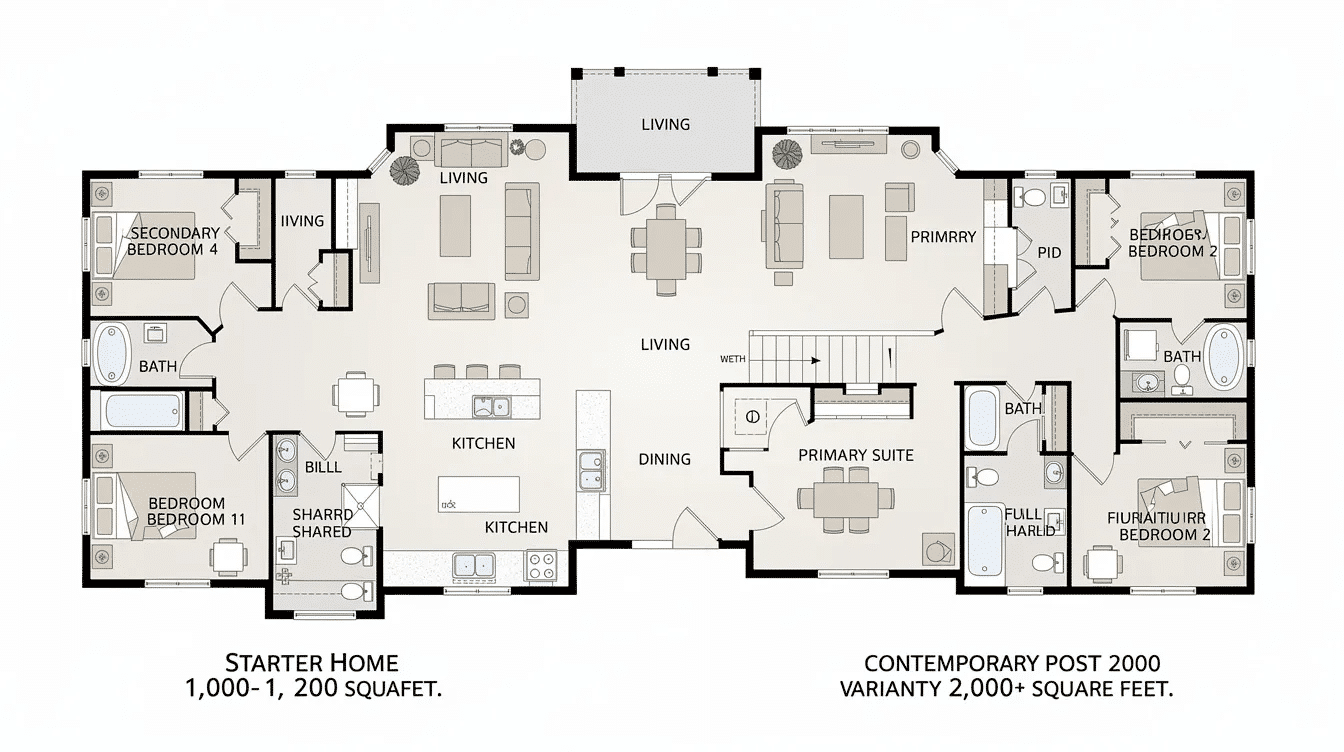
Hip roof ranch houses favor open, practical layouts organized for efficient daily living. The single-story configuration makes these homes suitable for families at any stage, from raising children to aging in place without navigating stairs, and understanding average ranch house dimensions can help you choose a layout that fits both your lot and lifestyle.
Square footages span a wide range. Compact starter homes measure 1,000 to 1,200 square feet, typically offering two family bedrooms plus a primary suite and one full bath. Contemporary ranches built after 2000 frequently reach 2,000 or more square feet, incorporating additional bedrooms, expanded living areas, and multiple bathrooms, as seen in many comfortable and stylish ranch homes that showcase how flexible this footprint can be.
Zone | Typical Rooms | Location |
|---|---|---|
Public | Living room, kitchen, dining area | Front or center of house |
Private | Primary suite, other bedrooms, bathrooms | Along one wing or rear |
Transitional | Mudroom, laundry, garage entry | Near garage access |
Floor plan organization follows this zoning pattern. The public zone handles entertaining and daily gathering. The private zone provides separation for rest and personal space. The transitional zone manages traffic flow between inside and outside. |
Kitchen configurations evolved significantly over time. Original 1960s floor plans featured enclosed kitchens intentionally separated from living spaces to contain cooking odors and noise. Open-concept kitchen-living areas became the dominant preference in homes remodeled after 2000, reflecting changing social patterns and desires for family interaction during meal preparation. Removing the wall between kitchen and living room typically requires structural modifications—a consideration addressed in the structural section below.
Bathroom distribution in original ranches often included just one full bath plus a primary suite with ensuite. Contemporary designs feature multiple full bathrooms spread among bedrooms for convenience.
Despite the single-story form, hip roof ranches can accommodate ceiling variations. Tray ceilings or cathedral ceilings in great rooms create vertical interest and visual volume. Some primary suites feature rear patio access through sliding glass doors, connecting the bedroom to outdoor space while maintaining privacy from public areas.
When evaluating ranch-style house plans, there are several things to keep in mind, such as land requirements, privacy, noise levels, and energy efficiency, to ensure the floor plan fits your needs and lifestyle.
Design Ideas and Variations for Hip Roof Ranch Homes
The hip roof ranch proves highly adaptable across aesthetic preferences. Whether you’re drawn to mid-century modern minimalism, transitional details, modern farmhouse warmth, or coastal simplicity, this home style accommodates your vision.
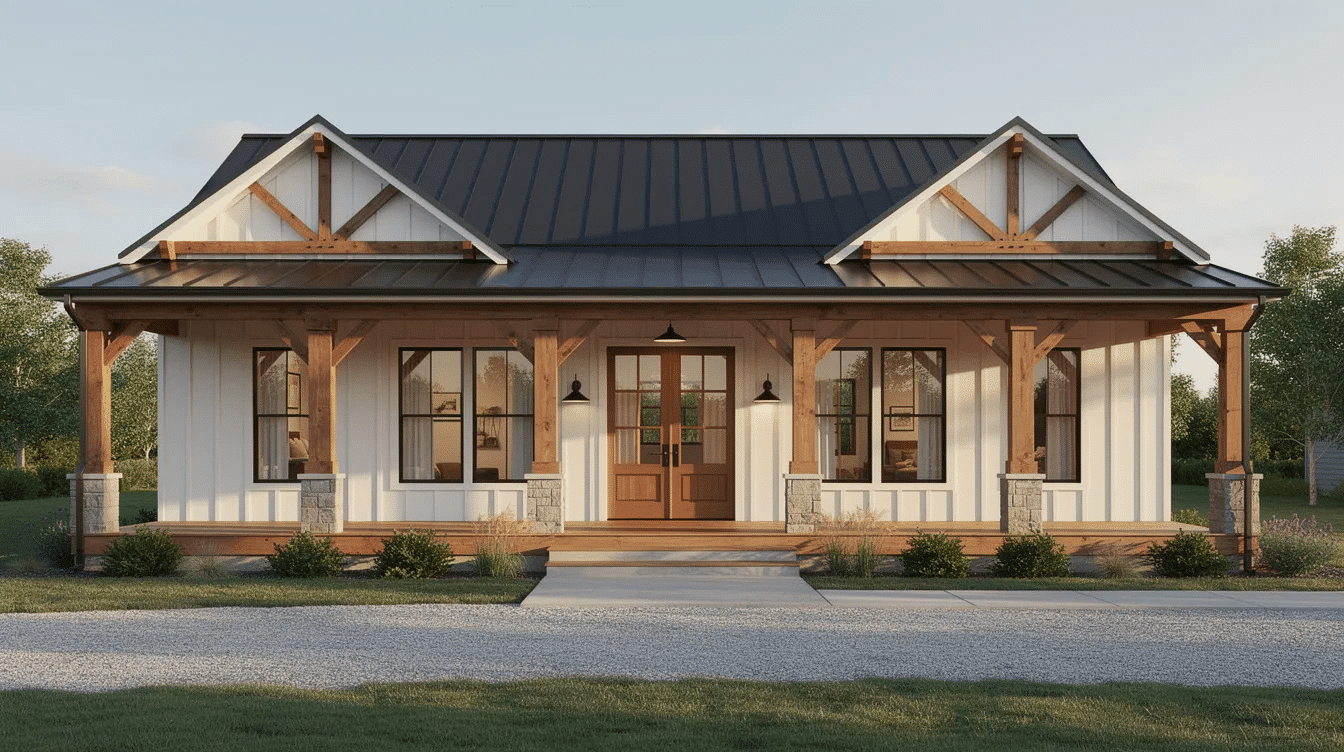
Regional variations reflect climate and architectural heritage. Southwest ranches emphasize stucco exteriors and clay tile roofing suited to desert conditions. Midwest builds historically featured brick veneer and asphalt shingles to handle temperature extremes. Coastal designs incorporate fiber-cement siding and metal accents that resist salt corrosion while creating a relaxed aesthetic, all while retaining the best features of a classic ranch style house such as strong indoor-outdoor connections and expansive windows.
Porch and outdoor living ideas expand the home’s footprint without interior construction. Deep front porches positioned under extended hip roof sections create shaded outdoor living that blends architecturally with the main structure. Wraparound verandas—common in Southern builds—utilize the continuous roof plane to provide covered circulation around multiple sides. Covered rear patios aligned with sliding glass doors extend indoor space outdoors, perfect for entertaining or quiet mornings.
Adding timber trusses to exterior gables introduces rustic character that references agricultural heritage while maintaining modern functionality. Integrating stone columns under extended eaves anchors the home visually and provides structural support for larger overhangs. Using black-framed windows throughout creates a 2020s modern look that makes pictures of contemporary ranches feel fresh and designer-inspired.
Landscape pairings reinforce the horizontal profile. Low foundation plantings emphasize the home’s linear spread rather than interrupting it with tall vertical elements. Simple concrete or paver walkways with minimal curves respect the home’s geometry. Backyard decks set at floor level visually extend the living space into the landscape, maintaining the home’s low, grounded appearance—an approach that pairs especially well with an all white ranch house design where clean lines and thoughtful landscaping create striking curb appeal.
Structural Considerations: Roof, Loads, and Renovations
While hip roofs are structurally stable, interior changes in a ranch—especially when you remove walls to create open floor plans—must be planned carefully. Understanding how loads distribute through the structure helps you work with professionals to make safe, code-compliant modifications. It is crucial to thoroughly read the structural elements before making any changes, including interpreting signs in the attic or within the walls to determine load paths and identify which walls are load bearing.
In a typical hip roof ranch, exterior walls carry most roof loads. The hip rafter system distributes weight evenly across all four sides, creating inherent stability. However, some interior walls function as load-bearing elements, supporting ceiling joists or beams that connect the roof structure to the building’s frame.
Consider a 1,000 square foot hip roof ranch built in the 1970s. An interior partition running perpendicular to the ceiling joists might support the ceiling without directly carrying roof loads. Removing this wall to create an open-concept space still requires structural attention because the ceiling framing depends on that support.
Widening an opening or removing a wall typically requires installing a structural beam—commonly doubled 2x10s or engineered lumber—to carry loads previously supported by the removed section. Temporary shoring walls must be installed during construction to prevent ceiling sag or structural failure. The deeper the span, the larger the beam required; spans exceeding 16 feet may demand steel I-beams.
Before altering any framing, check local building codes and obtain required permits. Consulting a licensed structural engineer or qualified contractor is essential—not optional. Experts agree that proper structural assessment is necessary before making any changes. Modern renovations sometimes add small dormers or raise a roof section for extra light, which also demands professional structural design to ensure proper load transfer and weather sealing.
Benefits of Ranch House Living
Ranch house plans are celebrated for their versatility and comfort, making them a top choice for homeowners seeking a practical and welcoming home. One of the standout benefits of a ranch house is its single-level layout, which eliminates stairs and creates an accessible environment for everyone—from young children to older adults. This makes ranch house plans especially appealing for families who want a home that adapts to changing needs over time.
Flexibility is at the heart of ranch house designs. Whether you need two or more bedrooms, a spacious family room, or a dedicated home office, ranch house plans can be tailored to fit your lifestyle. Many plans include the option to add a basement, instantly increasing your living and storage space. A finished basement can provide extra bedrooms, a playroom for kids, or a quiet retreat for guests, all while keeping the main floor organized and clutter-free.
The primary suite is typically located on the main floor, offering privacy and convenience. If your family grows or your needs change, it’s often easier to expand a ranch house with ground-floor additions than with multi-story homes. The straightforward construction of ranch house plans also means they are generally more affordable to build and maintain, maximizing your investment without sacrificing comfort or style.
With so many ranch house plans available, you can find the perfect fit for your needs—whether you’re dreaming of a cozy starter home or a sprawling, luxurious retreat. The combination of practical floor plans, efficient use of space, and adaptable designs ensures that there’s a ranch house plan out there for every family and every budget.
Landscaping and Outdoor Spaces
A thoughtfully designed outdoor space is the perfect complement to any ranch house, enhancing both its beauty and functionality. Features like a rear patio or covered porch can transform your home into a haven for family gatherings, quiet mornings, or lively celebrations. Sliding glass doors are a popular choice in ranch house plans, seamlessly connecting the interior living areas with outdoor patios and decks. This creates a natural flow between inside and outside, making it easy to enjoy fresh air and scenic views from the comfort of your home.
When planning your landscaping, consider how the exterior of your ranch house interacts with the surrounding environment. Large windows and doors not only bring in natural light but also frame picturesque views of your yard, garden, or countryside. Many homeowners find inspiration in country and historic garden styles, using native plants, stone pathways, and shaded porches to create inviting outdoor spaces that reflect the character of their home.
There are plenty of ideas and pictures online to help you find the perfect style for your outdoor space. Whether you prefer a modern look with clean lines or a more rustic, country-inspired setting, you can create a rear patio or porch that enhances your home’s exterior and provides a welcoming place for family and friends to gather. By integrating features like outdoor seating, fire pits, or even a small kitchen, you can extend your living space and make the most of every season.
With the right plan and a bit of creativity, your ranch house’s outdoor spaces can become a true extension of your home—offering beauty, inspiration, and plenty of room to relax, play, and connect with nature.
Budgeting and Cost Considerations
When it comes to building or buying a ranch house, careful budgeting is essential to ensure you get the most value from your investment. The cost of ranch house plans can vary significantly based on the size of the house, the number of bedrooms and bathrooms, and the features you choose to include. Simpler designs with fewer customizations tend to be more affordable, while larger homes with luxury finishes or unique architectural details may require a higher budget, especially if you’re aiming for the kind of beautiful ranch home where style meets functionality that blends open layouts with strong indoor-outdoor connections.
Start by setting a clear budget that accounts for both the initial construction or purchase price and ongoing expenses like maintenance, utilities, and property taxes. Many websites offer a wide selection of ranch house plans for sale, allowing you to compare designs and prices to find one that fits your needs. Some sites even provide a “contact us” option or email newsletter, so you can stay updated on new plans, promotions, and helpful tips.
When reviewing house plans, consider which features are most important to you—such as the number of bedrooms, the layout of the kitchen, or the inclusion of a basement. Prioritize your must-haves and be willing to compromise on less critical elements to stay within your budget. Remember, the cost of building a ranch house can also be influenced by local labor rates, material prices, and site conditions, so it’s wise to get multiple quotes and consult with professionals before making final decisions.
By doing your research and planning ahead, you can find a ranch house plan that offers the right balance of cost, comfort, and style—ensuring your new home is both beautiful and budget-friendly.
Pros and Cons of Hip Roof Ranch Houses
Hip roof ranches combine distinct advantages with trade-offs that buyers and renovators should weigh carefully before committing to this style.
Key Advantages:
Benefit | Why It Matters |
|---|---|
Single-level accessibility | No stairs create easy circulation for all ages |
Wind resistance | Hip roofs perform well in high-wind and hurricane regions |
Simple circulation | All rooms connect on one floor for efficient daily living |
Strong curb appeal | Symmetrical appearance creates market recognition |
The roof’s four-sided slope reduces wind uplift forces that affect gable roofs with vertical ends. Insurance companies in coastal areas often recognize this with lower premiums. Single-story living eliminates mobility barriers, making the style ideal for aging in place. |
Notable Drawbacks:
Hip roof ranches require larger lots due to their spread-out footprints. A 2,000 square foot ranch occupies significantly more site area than a two-story home with equivalent floor space. Roof construction cost tends higher than simple gable roofs because hip framing involves more complex carpentry and additional materials.
The greater exterior surface area can affect energy use, particularly in extreme climates. Open layouts—while popular—can increase noise transmission and reduce privacy between rooms, especially if original walls have been removed.
Energy-efficiency strategies help offset these concerns. Added attic insulation under the hip roof reduces thermal transfer. High-efficiency windows minimize heat gain and loss. Modern HVAC zoning allows selective conditioning of occupied spaces, keeping cost and energy use manageable.
Planning, Customizing, and Finding a Hip Roof Ranch Plan
Buyers pursuing a hip roof ranch can choose from stock house plans, modify existing homes, or commission custom designs from a designer or architect. Each approach offers different balances of cost, customization, and timeline.
When evaluating plans, consider bedroom count (typically three bedrooms suit most family needs), bathroom distribution, garage orientation relative to your lot, and whether the hip roof can accommodate features like solar panels or skylights. Think about how your needs might change over 10 to 20 years—accessible bathrooms, minimal steps from garage to kitchen, and first-floor primary suites all support aging in place.
Practical customizations that fit the hip roof form include extending the rear wall for a larger great room, adding a covered patio under an extended roof section, or finishing a full basement where soil conditions and water tables permit. These modifications expand living space while maintaining architectural coherence.
Before selecting or modifying a plan, compile accurate measurements, assess site conditions including lot slope and prevailing winds, and research local design restrictions. Understanding sun path helps position windows for optimal light and thermal performance. Contact local building departments to confirm setback requirements and any architectural review guidelines.
Whether you find inspiration through an online plan service or work directly with a local builder, the hip roof ranch remains a perfect fit for those seeking efficient, accessible, single-story living with proven structural performance and timeless appeal.
Finalizing Your Hip Roof Home
Bringing your hip roof ranch house vision to life is an exciting process that involves thoughtful planning and attention to detail. As you finalize your house plan, consider the features that matter most to you—whether it’s a spacious rear patio for entertaining, a full bath for each family bedroom, or a large, open kitchen that serves as the heart of your home. Explore hip roof ideas and browse inspiration online to discover layouts and design elements that fit your lifestyle and aesthetic preferences.
Many websites offer tools to help you create or customize your own plan, allowing you to adjust room sizes, add features, or experiment with different exterior finishes. Before making any commitments, review the site’s privacy policy and terms of use to ensure your personal information is protected. If you have questions or need expert advice, don’t hesitate to contact a designer or builder—they can help you navigate choices about materials, insulation, natural light, and ventilation to ensure your home is comfortable and energy-efficient.
Acknowledge the importance of details like window placement, wall insulation, and the flow between rooms when finalizing your plan. These elements not only impact the beauty and functionality of your home but also its long-term comfort and value. With the right combination of inspiration, planning, and professional guidance, you can create a hip roof ranch house that’s perfectly tailored to your needs—offering timeless style, practical features, and a welcoming space for your family to enjoy for years to come.