
Most working ranches operate on thin margins—typically 2–4% ROI from cattle operations alone. The real money often comes from land appreciation, tax advantages, and stacking multiple revenue streams beyond livestock sales. Ranch land can appreciate over time, may qualify for tax exemptions, and serves as both a lifestyle asset and a long-term investment. Understanding this reality is essential before you borrow money to buy ranch property. Ranch means more than just running cattle—it can serve as a means of investment, income generation, and long-term asset security.
Profitability depends on several interconnected factors: how much you pay for the land, your debt level, management skill, and whether you build income from cattle, hunting leases, agritourism, or direct-to-consumer beef sales. Current market conditions matter too. USDA’s 2024 forecast shows U.S. farm real estate averaging around $4,400 per acre, while cattle prices remain strong through 2026 due to historically low national herd numbers.
This article separates expectations for a working ranch from those of a lifestyle property. Many ranchers make the mistake of assuming cattle alone will pay the bills—then struggle when reality hits. Most ranchers focus on selling commercial calves rather than pursuing elite breeding programs or value-added sales, which highlights the difference between common practices and more specialized, potentially higher-margin strategies. Whether you want to raise livestock for profit or simply enjoy owning undeveloped land with recreational value or a classic ranch-style house with indoor-outdoor living, the financial calculus differs dramatically.
Key profitability levers to understand:
- Land acquisition cost and financing terms
- Debt-to-equity ratio (too much debt kills cash flow)
- Operational efficiency and grazing management
- Number of revenue streams beyond cattle
- Time horizon for land appreciation
- What Does “Profitable Ranch Ownership” Really Mean?
- Key Revenue Streams: How Do Ranches Actually Make Money?
- Working Cattle Ranch Economics: Can the Herd Pay the Bills?
- Beyond Cattle: Diversified Income Streams That Boost Profitability
- Cost Structure: What Really Eats Ranch Profits?
- Tax Advantages, Appreciation, and Wealth-Building Potential
- Lifestyle Ranch vs. Working Business Ranch: Setting Expectations
- How to Improve Ranch Profitability if You Already Own Land
- Is Owning a Ranch Profitable for You? A Decision Checklist
What Does “Profitable Ranch Ownership” Really Mean?
Ranch ownership can be profitable in three distinct ways: annual operating profit (cash flow from livestock operations), total return (cash flow plus land appreciation), and non-financial returns like lifestyle, privacy, and family legacy. Conflating these leads to unrealistic expectations.
Consider this concrete example: a 500-acre ranch purchased at $2,500 per acre in 2014 cost $1.25 million. If that same property is worth $4,000 per acre in 2024, it’s now valued at $2 million—a $750,000 gain over ten years. Even if annual operating income was only $20,000–$30,000 from cattle, the total return looks reasonable. But if the mortgage payment was $60,000 annually, the owner might be cash-flow negative while still building significant wealth.
Contrast two scenarios: a hobby ranch losing $20,000 per year on operations but gaining $150,000 in market value over five years, versus a highly efficient cow calf operation generating positive cash flow each year. The IRS distinguishes between hobby and business based on profit motive, record-keeping, and years showing profit. If classified as a hobby, losses become non-deductible.
Why defining profit matters:
- Lifestyle buyers can accept operational losses if land appreciates
- Working ranchers need positive cash flow for living expenses
- Tax treatment varies based on business classification
- Financial projections must match your actual goals
Key Revenue Streams: How Do Ranches Actually Make Money?
Most profitable ranches stack multiple income sources rather than relying on cattle alone. The logic is straightforward: if commodity prices crash, leasing land or agritourism can sustain the operation. If drought reduces carrying capacity, custom grazing or hay production generates cash. Profitability depends on several interconnected factors: how much you pay for the land, your debt level, management skill, and whether you build income from cattle, hunting leases, agritourism, or direct-to-consumer beef sales. Ranch size is also a key factor—larger ranches often benefit from economies of scale, while smaller ranches can still be profitable with careful management and diversified income streams.
The main categories include livestock operations (cow-calf, stocker, breeding stock), hay and forage sales, grazing leases to neighboring ranchers, hunting and recreation leases, short-term rentals in comfortable, well-designed ranch homes, direct-to-consumer meat sales, and specialty enterprises like seedstock genetics or grass fed beef programs.
Concrete numbers help set expectations: a 300-cow spring-calving ranch with 85% calf crop percentage, weaning calves at 550 pounds and selling at $2.40 per pound, grosses roughly $1,100 per cow annually. A hunting lease on 1,000 acres in Texas might generate $10–$25 per acre annually ($10,000–$25,000 total) for minimal effort. A vacation cabin near a resort area could bring $150–$300 per night during peak season.
Working Cattle Ranch Economics: Can the Herd Pay the Bills?
This is the core question for traditional cattle ranch buyers: can a cow calf operation or stocker herd pay the mortgage, cover living costs, and fund reinvestment?
Using a concrete example: a 300-cow spring-calving operation in central U.S. with 85% calf crop, weaning calves at 550 pounds, and selling at $2.40 per pound generates approximately $330,000 in gross revenue. Direct costs (vaccines, minerals, veterinary, supplemental feed) run about $305 per cow, or $91,500 total. Land and labor allocation adds another $400 per cow ($120,000 total). After these costs, net profit before debt service shrinks dramatically—often to $44–$138 per cow for average operations.
Many ranches barely break even after accounting for all costs. The top 20% of operators achieve returns near 10% on assets, while average livestock operations show slim to negative financial returns. Scale matters—500+ cows gains economies of labor efficiency—but small ranches can compete through custom grazing, niche markets, or running lean on existing infrastructure.
Revenue from Cow-Calf Operations
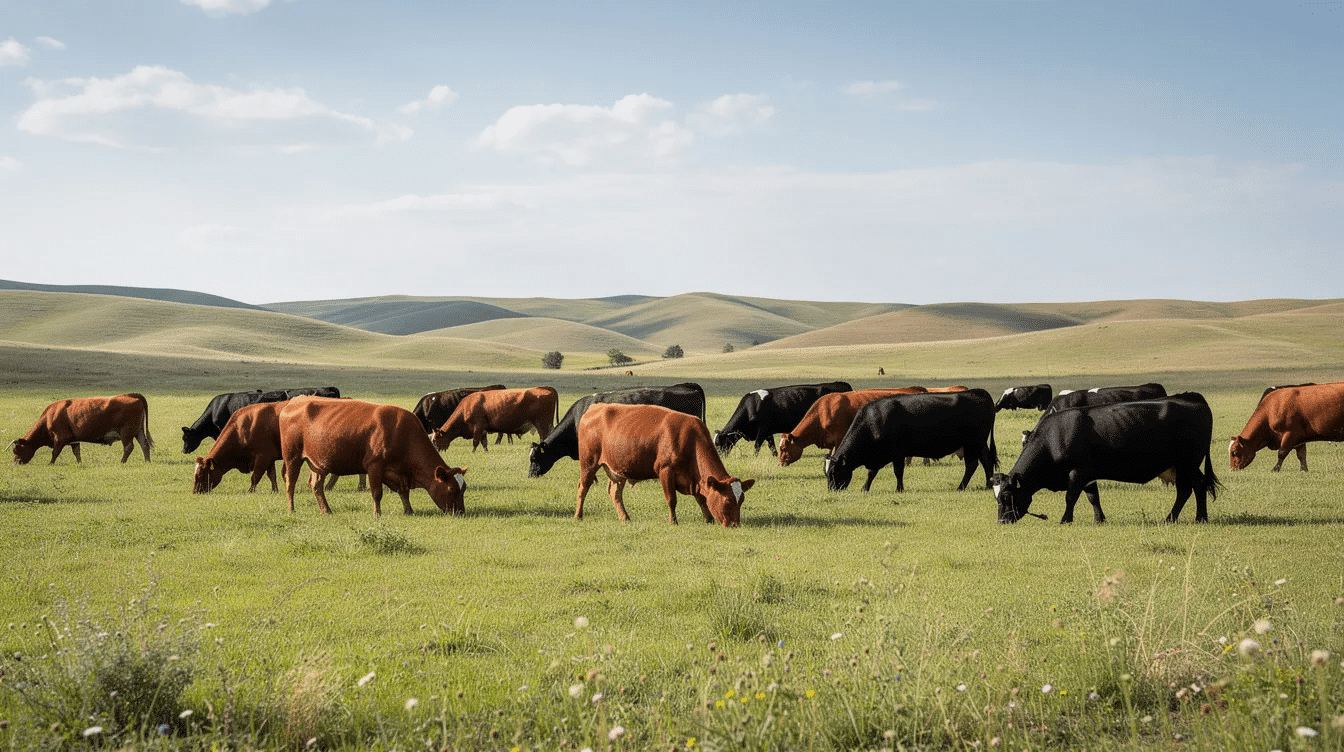
The cow calf model is foundational: breeding cows calve once annually, calves are raised on pasture, and weaned calves sell at 6–9 months. A clear calculation: 200 cows × 0.90 calves weaned × 550 lbs × $2.40/lb = approximately $237,600 gross revenue, or $1,188 per cow.
Key drivers include pregnancy rate (the percentage of cows that breed successfully), calf survival, weaning weight, and timing sales relative to the cattle business cycle. Modest improvements compound quickly—increasing calf survival from 90% to 95% on a 300-cow herd adds 45 uniform calves, representing $59,400 additional gross revenue at those weights and prices.
Stocker and Backgrounder Strategies
Stocker operations buy lighter calves (typically 400 pounds), add 250–350 pounds on pasture or cheap fed feed, and resell to feedlots. The profit calculation: buy a 400-pound calf at $2.80/lb ($1,120), add weight through grazed feed over 180 days, then sell at 700 pounds at $2.00/lb ($1,400). After grazing and supplement costs of approximately $220, gross profit runs $60 per head.
This model is more sensitive to feed and pasture costs but requires lower ownership costs when land is leased. Some ranch operations run both cow-calf and stockers to utilize forage seasonally and spread fixed costs.
Value-Added and Direct-to-Consumer Beef
Selling quarters, halves, or retail cuts directly to consumers can increase revenue per animal significantly. A finished steer sold through conventional sale barn channels might gross $1,600. That same steer processed and sold direct to customers as grass fed beef can generate $2,000–$2,400.
Requirements include freezer space, access to USDA-inspected processing, a website or social media presence, and time for customer service. Processing costs run $0.60–$1.00 per pound hanging weight. Small ranches near metro areas can sometimes earn more through direct sales than by scaling cow numbers, capturing retail premiums that boost margins to 30–40%.
Beyond Cattle: Diversified Income Streams That Boost Profitability
Non-cattle revenue often transforms a marginal ranch into a profitable business. Ranches offer unique opportunities based on location, wildlife habitat, and landscape character that many owners underutilize.
Options include hunting leases for deer, elk, or waterfowl; fishing access fees; short-term rentals in restored cabins or beautiful ranch-style homes that blend style and functionality or glamping structures; farm stays; event hosting for weddings or corporate retreats; hay production and custom grazing; and conservation easement or carbon credit programs where available.
A 1,000-acre property in Texas leasing hunting rights generates $10,000–$25,000 annually with minimal management. A Wyoming guest ranch cabin or ranch-style house with a loft for flexible guest space might book for $200–$300 per night, potentially generating $35,000–$75,000 annually at 50% occupancy. Diversification should match your property’s characteristics—water availability, easy access to population centers, and local regulations all shape what’s viable.

Leasing Land: Grazing, Farming, and Hunting
Common lease types include seasonal grazing leases to neighboring ranchers (typically $0.15–$0.35 per animal unit month in Great Plains and Mountain West), crop leases to local farmers, and hunting leases to outfitters or individual hunters.
Benefits include relatively passive income, reduced need to own cattle or equipment, and steady cash flow even when cattle prices weaken. Many ranchers overlook leasing as a strategy, but it can generate income from land associated costs you’re already paying.
Risks include lease disputes, liability exposure, and potential overuse impacting land condition. Written agreements, appropriate insurance, and clear expectations protect both parties.
Recreation, Agritourism, and Short-Term Rentals
Recreational ranches near national parks, ski towns, or major cities can earn substantial income from nightly rentals, guided trail rides, UTV tours, or seasonal events. A Wyoming guest ranch might charge $2,500–$3,500 per person per week for all-inclusive stays. A small Texas ranch listing a restored bunkhouse or Craftsman-style cabin retreat on platforms like Airbnb might generate $36,600 annually at $200/night and 50% occupancy.
This strategy requires local zoning compliance, safety standards, and extra liability coverage. Per-acre returns can exceed cattle, but success demands hospitality skills and significant time commitment. Not every ranch manager wants strangers on their property regularly.
Cost Structure: What Really Eats Ranch Profits?
Understanding costs matters as much as boosting revenue when evaluating whether owning a ranch will be profitable. High prices for land combined with modern interest rates create structural challenges many ranchers underestimate.
Major cost categories include land (purchase or rent), interest and principal payments, property taxes and insurance, feed and pasture improvement, hired labor and operator draw, machinery and fuel, fencing and existing infrastructure maintenance, and compliance costs, all of which apply whether you own a contemporary ranch operation or a historic ranch house with deep architectural roots.
A worked example: a 300-cow operation on 3,000–4,000 acres in central U.S. might face $137,000 annual debt service on a $1.5 million mortgage, $15,000–$30,000 in property taxes, $91,500 in direct costs, $80,000 in land and labor allocation, and $55,000 in overhead. Total costs approach $400,000 against gross revenue of $330,000—a significant annual deficit before owner draw.
Land, Debt, and Interest Payments
The price per acre and amount financed largely determine whether agricultural operations can cover payments from livestock sales alone. Financing a $3 million ranch at 6.5% interest over 25 years costs approximately $138,000 annually in principal and interest.
For this to be manageable, the ranch should generate $300,000–$400,000 in gross revenue. A 300-cow operation barely meets this threshold before other costs. This explains why multigenerational ranches often show better profitability—land was acquired decades ago at far lower prices.
Conservative borrowing (40–50% down payment), large equity positions, or off-farm income are common strategies among successful ranch owners who avoid carrying too much debt.
Feed, Grazing, and Infrastructure Costs
Purchased feed represents the largest variable cost for most ranches. More grazed feed means better margins. Rotational grazing management, stockpiling forage for winter, and aligning calving season with natural grass growth can cut hay and supplement needs dramatically.
A concrete comparison: overwintering a cow with mostly stored hay (20 pounds daily for 150 days at $0.06/lb) costs $180. The same cow on stockpiled forage with minimal supplement might cost $40–$60. Across a 300-cow herd, that’s $36,000–$48,000 in annual savings—often the difference between profitable and unprofitable.
Infrastructure investments in fencing and water systems pay off if they increase grazing days and improve labor efficiency. But heavy equipment and large buildings can burden small ranches indefinitely.
Tax Advantages, Appreciation, and Wealth-Building Potential
Many ranch owners accumulate wealth not from annual ranch profits, but from land appreciation and tax benefits over 10–30 year holding periods. This explains why patient capital often targets ranch investments despite modest cash flow.
Mechanisms include agricultural use valuation for property taxes (reducing bills by 30–70% in developing areas), deductibility of legitimate business expenses, depreciation on qualifying improvements, and 1031 exchanges allowing tax-deferred reinvestment when selling.
Consider a ranch bought in 2010 for $1.5 million, improved modestly over time, operated near break-even annually, and sold in 2025 for $2.4 million. The $900,000 capital gain—taxed at long-term rates of 15–20%—yields $720,000–$765,000 after federal tax. That’s roughly $48,000–$51,000 annually in total return, far exceeding the 2–3% annual cash-on-cash many ranchers see.
Consult a CPA familiar with agricultural operations in your state. Rules on ag use valuation, mineral rights taxation, and depreciation schedules vary significantly.
Lifestyle Ranch vs. Working Business Ranch: Setting Expectations
A lifestyle ranch prioritizes privacy, recreation, and family legacy, much like ranch-style homes that emphasize comfort and relaxed living. A working business ranch prioritizes generating income to support the owners. Most ranches fall somewhere on this spectrum.
A lifestyle owner might accept $20,000–$30,000 annual operational losses in exchange for enjoyment, betting on land appreciation and tax planning. This works when substantial off-farm income exists—a physician earning $250,000 annually might subsidize a ranch at 1% of income while building equity over 15 years.
A working rancher needs the ranch to generate family income. This requires tight cost control, clear business plans, adequate scale or niche strategy, and treating ranch operations like a serious company. Before buying, honestly assess which camp you’re in. How many cows can you realistically run? Can you supplement with off-farm income? Are you willing to track metrics rigorously?
How to Improve Ranch Profitability if You Already Own Land
Even marginal ranches can become profitable through systematic changes. Better grazing management is often the highest-ROI improvement—transitioning to rotational grazing can add $150–$250 per head in profitability by reducing hay and supplement costs.
Smarter herd genetics and culling removes unproductive animals. Purchasing a superior bull ($2,000–$8,000) can improve weaning weight by 30–50 pounds across the herd. On 200 cows, that’s 8,000 pounds of additional calf weight annually—$19,200 in additional gross revenue.
Adding income streams transforms economics. A 500-acre ranch might list a restored cabin on Airbnb ($20,000–$30,000 annually), lease hunting rights ($5,000–$15,000), and run a modest cattle herd. Diversified revenue makes the combined operation viable even when individual streams are modest.
Track metrics obsessively: profit per cow, per acre, per labor hour. Identify your weakest metric—poor calf crop percentage, light weaning weight, excessive feed costs—and target improvement where ROI is highest.
Is Owning a Ranch Profitable for You? A Decision Checklist
Owning a ranch can be a good investment, but success combines realistic expectations, strong management, multiple revenue streams, and patience over market cycles. Before purchasing, work through this checklist honestly.
Write out a simple 5–10 year projection including purchase price, expected operational income, property taxes and interest, and conservative land appreciation assumptions. If projections show positive cash flow within 3 years or acceptable total return within 10 years, the opportunity warrants serious consideration.
Critical questions to answer:
- Do you have 40–50% available for down payment?
- Can you manage debt service below 30% of gross ranch income?
- Will you treat this as a business or accept it as a lifestyle expense?
- Do you have access to markets for direct sales or agritourism?
- Are you prepared for hands-on labor and long hours?
- Can you accept minimal short-term cash in exchange for long-term wealth?
- Are you open to diversification beyond cattle—leases, tourism, direct sales?
The honest answer to whether most ranches are profitable: operations alone rarely generate significant annual returns. But ranch ownership can absolutely build wealth through appreciation, tax advantages, and diversified income—if you enter with clear expectations, manage like a real estate professional would manage any asset, and commit to the long game.